ADP2303
ADP2303 is Nonsynchronous Step-Down Regulators manufactured by Analog Devices.
- Part of the ADP2302 comparator family.
- Part of the ADP2302 comparator family.
Data Sheet
2 A/3 A, 20 V, 700 k Hz, Nonsynchronous Step-Down Regulators
ADP2302/ADP2303
Features
Wide input voltage range: 3.0 V to 20 V Maximum load current
2 A for ADP2302 3 A for ADP2303 ±1.5% output accuracy over temperature Output voltage down to 0.8 V 700 k Hz switching frequency Current-mode control architecture Automatic PFM/PWM mode Precision enable pin with hysteresis Integrated high-side MOSFET Integrated bootstrap diode Internal pensation and soft start Power-good output Undervoltage lockout (UVLO) Overcurrent protection (OCP) Thermal shutdown (TSD) 8-lead SOIC package with exposed paddle Supported by ADIsim Power™ design tool
APPLICATIONS
Intermediate power rail conversion DC-to-DC point of load applications munications and networking Industrial and instrumentation Healthcare and medical Consumer
GENERAL DESCRIPTION
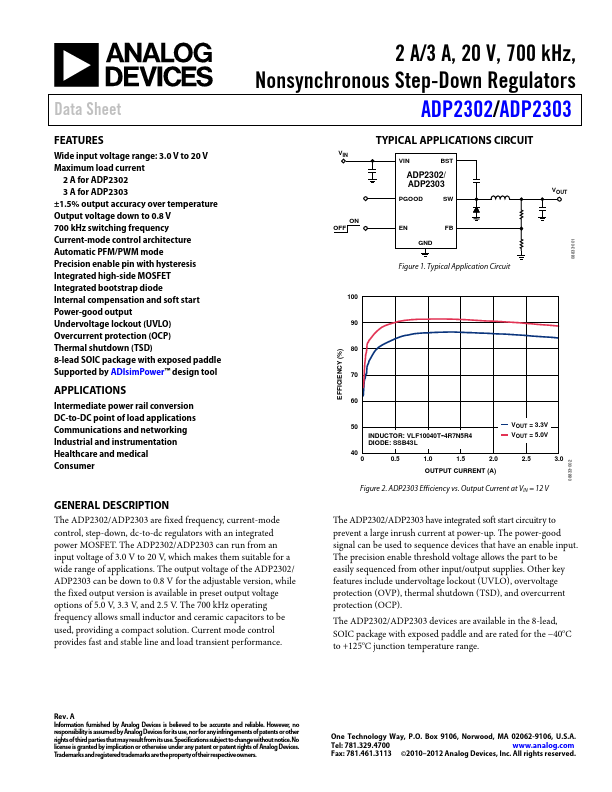
The ADP2302/ADP2303 are fixed frequency, current-mode control, step-down, dc-to-dc regulators with an integrated power MOSFET. The ADP2302/ADP2303 can run from an input voltage of 3.0 V to 20 V, which makes them suitable for a wide range of applications. The output voltage of the ADP2302/ ADP2303 can be down to 0.8 V for the adjustable version, while the fixed output version is available in preset output voltage options of 5.0 V, 3.3 V, and 2.5 V. The 700 k Hz operating frequency allows small inductor and ceramic capacitors to be used, providing a pact solution. Current mode control provides fast and stable line and load transient performance.
TYPICAL APPLICATIONS CIRCUIT
VIN VIN BST
ADP2302/ ADP2303
PGOOD
VOUT
ON OFF
EN GND
Figure 1. Typical Application Circuit
08833-001
EFFICIENCY (%)
INDUCTOR: VLF10040T-4R7N5R4
DIODE: SSB43L
40 0
0.5 1.0 1.5
OUTPUT CURRENT (A)
VOUT = 3.3V VOUT = 5.0V
2.5 3.0
Figure 2. ADP2303 Efficiency vs. Output Current at VIN = 12 V
08833-002
The ADP2302/ADP2303 have integrated soft start circuitry to prevent a large inrush current at power-up. The...