Datasheet4U Logo Datasheet4U.com

ADUM3210 - Enhanced System-Level ESD Reliability

Description

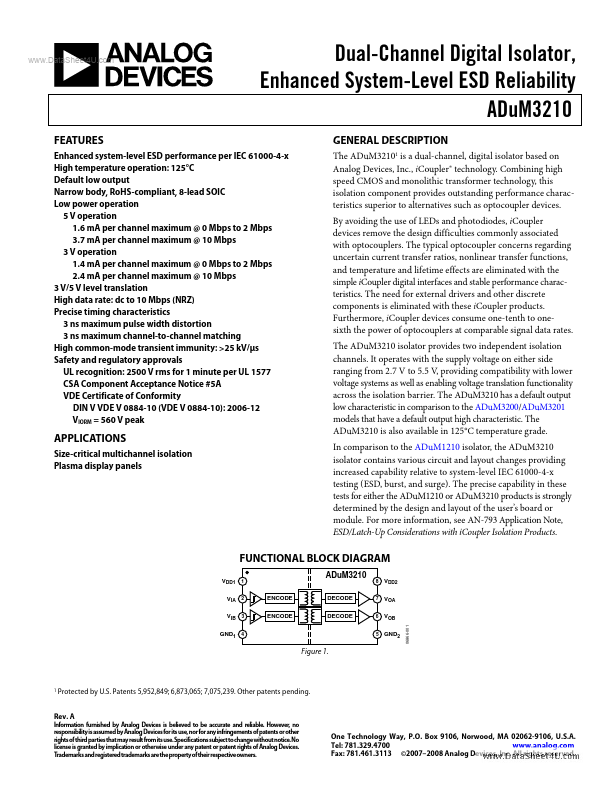
The ADuM32101 is a dual-channel, digital isolator based on Analog Devices, Inc., iCoupler® technology.

Combining high speed CMOS and monolithic transformer technology, this isolation component provides outstanding performance characteristics superior to alternatives such as optocoupler devices.

Features

  • Enhanced system-level ESD performance per IEC 61000-4-x High temperature operation: 125°C Default low output Narrow body, RoHS-compliant, 8-lead SOIC Low power operation 5 V operation 1.6 mA per channel maximum @ 0 Mbps to 2 Mbps 3.7 mA per channel maximum @ 10 Mbps 3 V operation 1.4 mA per channel maximum @ 0 Mbps to 2 Mbps 2.4 mA per channel maximum @ 10 Mbps 3 V/5 V level translation High data rate: dc to 10 Mbps (NRZ) Precise timing characteristics 3 ns maximum pulse width distortion 3 ns ma.

📥 Download Datasheet

Datasheet preview – ADUM3210

Datasheet Details

Part number ADUM3210
Manufacturer Analog Devices
File Size 751.70 KB
Description Enhanced System-Level ESD Reliability
Datasheet download datasheet ADUM3210 Datasheet
Additional preview pages of the ADUM3210 datasheet.
Other Datasheets by Analog Devices

Full PDF Text Transcription

Click to expand full text
www.DataSheet4U.com Dual-Channel Digital Isolator, Enhanced System-Level ESD Reliability ADuM3210 GENERAL DESCRIPTION The ADuM32101 is a dual-channel, digital isolator based on Analog Devices, Inc., iCoupler® technology. Combining high speed CMOS and monolithic transformer technology, this isolation component provides outstanding performance characteristics superior to alternatives such as optocoupler devices. By avoiding the use of LEDs and photodiodes, iCoupler devices remove the design difficulties commonly associated with optocouplers. The typical optocoupler concerns regarding uncertain current transfer ratios, nonlinear transfer functions, and temperature and lifetime effects are eliminated with the simple iCoupler digital interfaces and stable performance characteristics.
Published: |