Datasheet4U Logo Datasheet4U.com

ADXL1002 - High Frequency MEMS Accelerometers

Download the ADXL1002 datasheet PDF. This datasheet also covers the ADXL1001 variant, as both devices belong to the same high frequency mems accelerometers family and are provided as variant models within a single manufacturer datasheet.

General Description

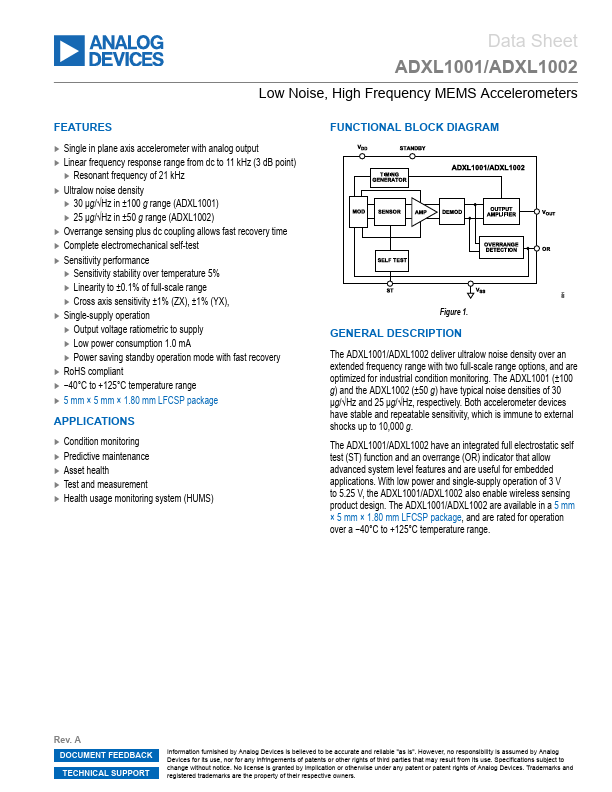
The ADXL1001/ADXL1002 deliver ultralow noise density over an extended frequency range with two full-scale range options, and are optimized for industrial condition monitoring.

The ADXL1001 (±100 g) and the ADXL1002 (±50 g) have typical noise densities of 30 µg/√Hz and 25 µg/√Hz, respectively.

Key Features

  • Single in plane axis accelerometer with analog output.
  • Linear frequency response range from dc to 11 kHz (3 dB point).
  • Resonant frequency of 21 kHz.
  • Ultralow noise density.
  • 30 µg/√Hz in ±100 g range (ADXL1001).
  • 25 µg/√Hz in ±50 g range (ADXL1002).
  • Overrange sensing plus dc coupling allows fast recovery time.
  • Complete electromechanical self-test.
  • Sensitivity performance.
  • Sensitivity stability over temperature 5%.
  • Linearity to ±0.1% of full-s.

📥 Download Datasheet

Note: The manufacturer provides a single datasheet file (ADXL1001-AnalogDevices.pdf) that lists specifications for multiple related part numbers.

Full PDF Text Transcription (Reference)

The following content is an automatically extracted verbatim text from the original manufacturer datasheet and is provided for reference purposes only.

View original datasheet text
Data Sheet ADXL1001/ADXL1002 Low Noise, High Frequency MEMS Accelerometers FEATURES ► Single in plane axis accelerometer with analog output ► Linear frequency response range from dc to 11 kHz (3 dB point) ► Resonant frequency of 21 kHz ► Ultralow noise density ► 30 µg/√Hz in ±100 g range (ADXL1001) ► 25 µg/√Hz in ±50 g range (ADXL1002) ► Overrange sensing plus dc coupling allows fast recovery time ► Complete electromechanical self-test ► Sensitivity performance ► Sensitivity stability over temperature 5% ► Linearity to ±0.1% of full-scale range ► Cross axis sensitivity ±1% (ZX), ±1% (YX), ► Single-supply operation ► Output voltage ratiometric to supply ► Low power consumption 1.