ADXL371
ADXL371 is MEMS Accelerometer manufactured by Analog Devices.
FEATURES
- ±200 g measurement range
- 160 Hz to 2560 Hz user selectable bandwidth with four-pole antialiasing filter
- Selectable oversampling ratio
- Adjustable high-pass filter
- Ultra low power
- Power can be derived from a coin cell battery
- 28 µA at 2560 Hz ODR, 3.3 V supply
- Low power, wake-up mode for low g activity detection
- 1.7 µA instant on mode with adjustable threshold
- <0.1 µA standby mode
- Built in features for system level power savings
- Deep embedded FIFO to minimize host processor load
- Autonomous interrupt processing without processor interven- tion
- Ultra low power event monitoring detects impacts and wakes up fast enough to capture the transient events
- Adjustable, low g threshold activity and inactivity detection
- Wide operating voltage range: 2.5 V to 3.5 V
- Acceleration sample synchronization via external trigger
- SPI digital interface and I2C interface format support
- 12-bit output at 100 mg/LSB scale factor
- Wide temperature range:
- 40°C to +105°C
- Small, thin, 3 mm × 3.25 mm × 1.06 mm package
APPLICATIONS
- Impact and shock detection
- Asset health assessment
- Portable Internet of Things (Io T) edge nodes
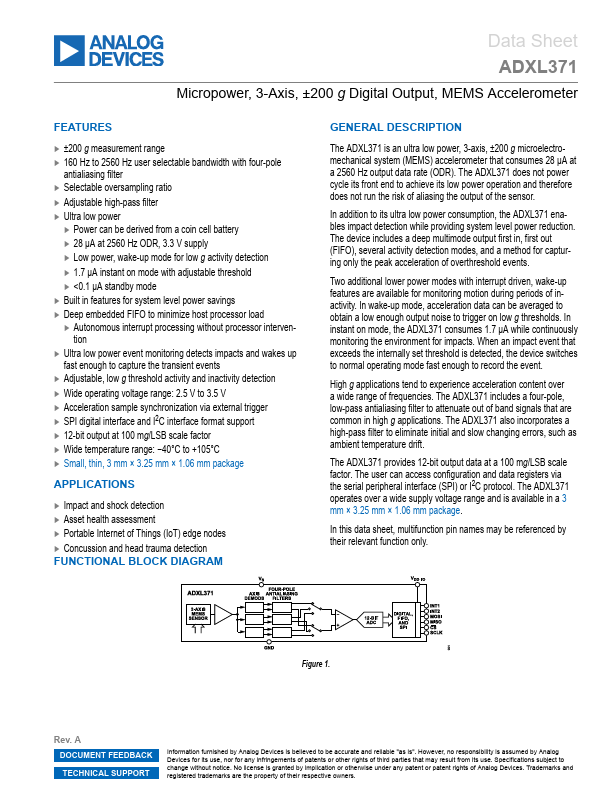
- Concussion and head trauma detection FUNCTIONAL BLOCK DIAGRAM
GENERAL DESCRIPTION
The ADXL371 is an ultra low power, 3-axis, ±200 g microelectromechanical system (MEMS) accelerometer that consumes 28 µA at a 2560 Hz output data rate (ODR). The ADXL371 does not power cycle its front end to achieve its low power operation and therefore does not run the risk of aliasing the output of the sensor. In addition to its ultra low power consumption, the ADXL371 enables impact detection while providing system level power reduction. The device includes a deep multimode output first in, first out (FIFO), several activity detection modes, and a method for capturing only the peak acceleration of overthreshold events. Two additional lower power modes with interrupt driven, wake-up features are available for monitoring motion during...