LTC3302
LTC3302 is 2A Synchronous Step-Down Regulator manufactured by Analog Devices.
FEATURES n High Efficiency: 30mΩ NMOS, 85mΩ PMOS n Peak Current Mode Control n 27ns Minimum On-Time n Wide Bandwidth, Fast Transient Response n Low-Ripple Burst Mode® Operation with IQ of 80µA n Up to 6MHz Operation n Safely Tolerates Inductor Saturation in Overload n VIN Range: 2.25V to 5.5V n Fixed VOUT Range: 0.5V to 3.65V, Factory Programmed in 50m V Steps n VOUT Accuracy: ±1% Overtemperature Range n Precision 400m V Enable Threshold n Shutdown Current: 1µA n Power Good, Internal pensation and Soft-Start n Thermally Enhanced, 12-Pin, 2mm × 2mm, Flip Chip (FCQFN) Package with Side Wettable Flanks n AEC-Q100 Qualified for Automotive Applications
APPLICATIONS n Optical Networking, Servers, Tele n Automotive, Industrial, munications n Distributed DC Power Systems (POL) n FPGA, ASIC, µP Core Supplies
DESCRIPTION
The LTC®3302 is a very small, high efficiency, low noise, monolithic synchronous 2A step-down DC/DC converter operating from a 2.25V to 5.5V input supply. Using constant frequency, peak current mode control, this regulator achieves fast transient response with small external ponents.
The LTC3302 operates in forced continuous or pulseskipping mode for low noise, or in low-ripple Burst Mode operation for high efficiency at light loads, ideal for battery-powered systems. The IC regulates output voltages as low as 500m V. The adjustable version operates from 500m V to VIN with two additional external resistors. Other features include output overvoltage protection, short-circuit protection, thermal shutdown, clock synchronization, and up to 100% duty cycle operation for low dropout.
The LTC3302 is available in a low profile 2mm × 2mm FCQFN package with exposed pad and side wettable flanks.
All registered trademarks and trademarks are the property of their respective owners.
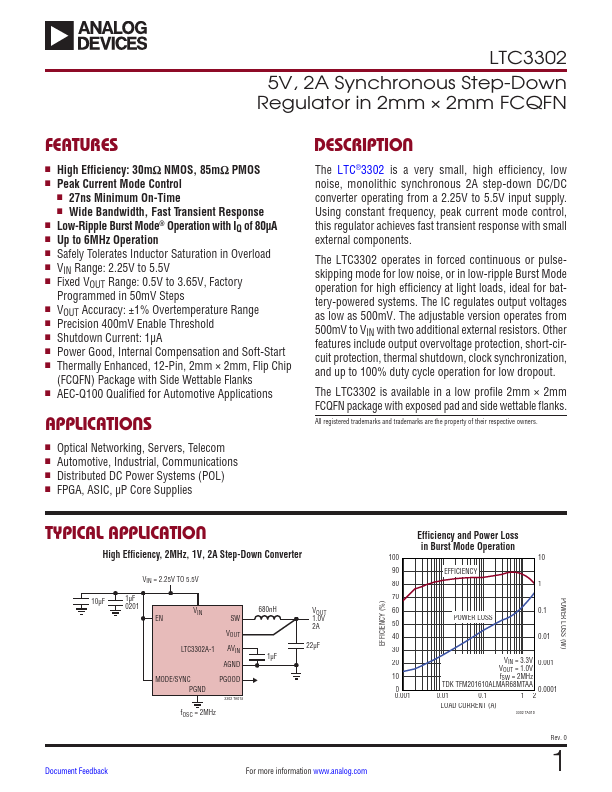
TYPICAL APPLICATION
High Efficiency, 2MHz, 1V, 2A Step-Down Converter
10µF
VIN = 2.25V TO 5.5V
1µF 0201
VOUT
LTC3302A-1 AVIN
AGND
MODE/SYNC PGND
PGOOD
3302 TA01a f OSC =...