LTC3897
LTC3897 is PolyPhase Synchronous Boost Controller manufactured by Analog Devices.
Features n Input Supply Range: 4.5V to 65V (Up to 75V Surge) n Reverse Input Protection to
- 40V n In-Rush Current Control, Overcurrent Protection and Output Disconnect for Boost Converter n Input Voltage Surge Protection with Adjustable
Clamp Voltage n Onboard Ideal Diode Controller n Low Quiescent Current: 55µA n 2-Phase Operation Reduces Required Input and
Output Capacitance and Noise n Output Voltage Up to 60V n Adjustable Gate Drive Level 5V to 10V (OPTI-DRIVE) for Logic-Level or Standard Threshold FETs n No External Bootstrap Diodes Required
APPLICATIONS n Industrial n Automotive n Military/Avionics
LTC3897 Poly Phase Synchronous Boost Controller with Input/
Output Protection DESCRIPTION
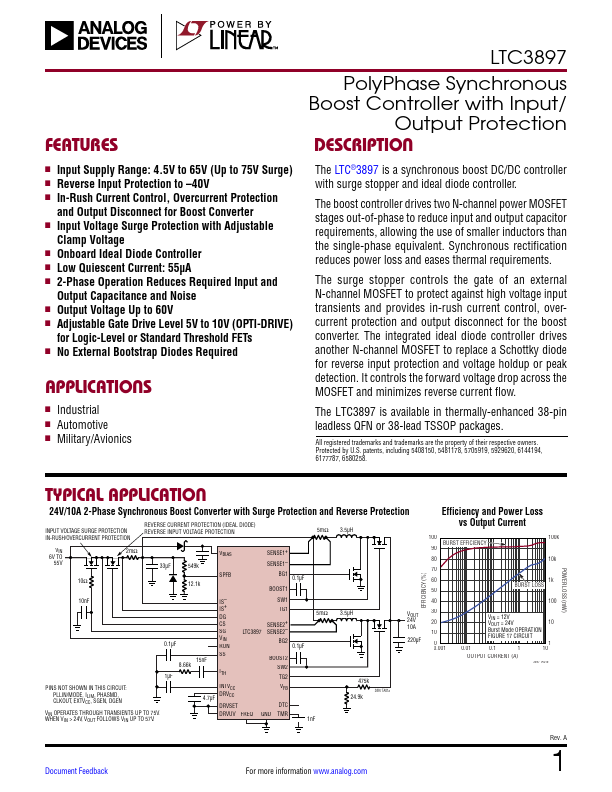
The LTC®3897 is a synchronous boost DC/DC controller with surge stopper and ideal diode controller. The boost controller drives two N-channel power MOSFET stages out-of-phase to reduce input and output capacitor requirements, allowing the use of smaller inductors than the single-phase equivalent. Synchronous rectification reduces power loss and eases thermal requirements. The surge stopper controls the gate of an external N-channel MOSFET to protect against high voltage input transients and provides in-rush current control, overcurrent protection and output disconnect for the boost converter. The integrated ideal diode controller drives another N-channel MOSFET to replace a Schottky diode for reverse input protection and voltage holdup or peak detection. It controls the forward voltage drop across the MOSFET and minimizes reverse current flow. The LTC3897 is available in thermally-enhanced 38-pin leadless QFN or 38-lead TSSOP packages.
All registered trademarks and trademarks are the property of their respective owners. Protected by U.S. patents, including 5408150, 5481178, 5705919, 5929620, 6144194, 6177787, 6580258.
POWER LOSS (m W)
TYPICAL APPLICATION
24V/10A 2-Phase Synchronous Boost Converter with Surge Protection and Reverse Protection
INPUT VOLTAGE...