LTC4291-1
LTC4291-1 is 4-Port IEEE 802.3bt PoE PSE Controller manufactured by Analog Devices.
FEATURES nn Four PSE Ports nn Two Power Channels per Port nn Fully pliant IEEE 802.3bt Type 3 and 4 PSE nn pliant Support for Type 1, 2, 3, and 4 PDs nn Low Power Path Dissipation per Channel nn 150mΩ Sense Resistance nn 30mΩ or Lower MOSFET RDS(ON) nn Chipset Provides Electrical Isolation nn Eliminates Optos and Isolated 3.3V Supply nn Very High Reliability Multipoint PD Detection nn Connection Check Distinguishes Single Signature and Dual-Signature PDs nn Continuous, Dedicated Per-Port Power and Current Monitoring nn Per-Port Power Policing nn 1MHz I2C patible Serial Control Interface nn Pin or I2C Programmable PD Power Up to 71.3W nn Available in a 40-Lead 6mm × 6mm (LTC4292) and
24-Lead 4mm × 4mm (LTC4291-1) QFN Packages
APPLICATIONS nn Po E PSE Switches/Routers nn Po E PSE Midspans
LTC4291-1/LTC4292
4-Port IEEE 802.3bt Po E PSE Controller
DESCRIPTION
The LTC®4291-1/LTC4292 chipset is a 4-port power sourcing equipment (PSE) controller designed for use in IEEE 802.3bt Type 3 and 4 pliant Power over Ethernet (Po E) systems. The LTC4291-1/LTC4292 is designed to power pliant 802.3af, 802.3at, and 802.3bt PDs. The LTC4291-1/LTC4292 chipset delivers lowest-in-industry heat dissipation by utilizing low RDS(ON) external MOSFETs and 0.15Ω sense resistance per power channel. A transformer-isolated munication protocol replaces expensive opto-couplers and plex isolated 3.3V supply, resulting in significant BOM cost savings.
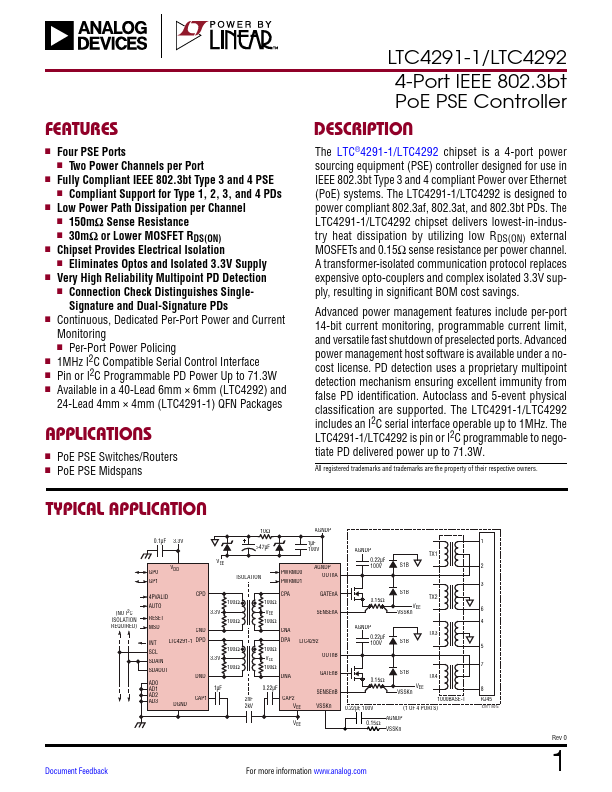
Advanced power management features include per-port 14‑bit current monitoring, programmable current limit, and versatile fast shutdown of preselected ports. Advanced power management host software is available under a nocost license. PD detection uses a proprietary multipoint detection mechanism ensuring excellent immunity from false PD identification. Autoclass and 5-event physical classification are supported. The LTC4291-1/LTC4292 includes an I2C serial interface operable up to 1MHz. The LTC4291-1/LTC4292 is pin or I2C programmable to negotiate PD...