Datasheet4U Logo Datasheet4U.com

MAX15106C - Synchronous Step-Down Switching Regulator

Download the MAX15106C datasheet PDF. This datasheet also covers the MAX15106A variant, as both devices belong to the same synchronous step-down switching regulator family and are provided as variant models within a single manufacturer datasheet.

General Description

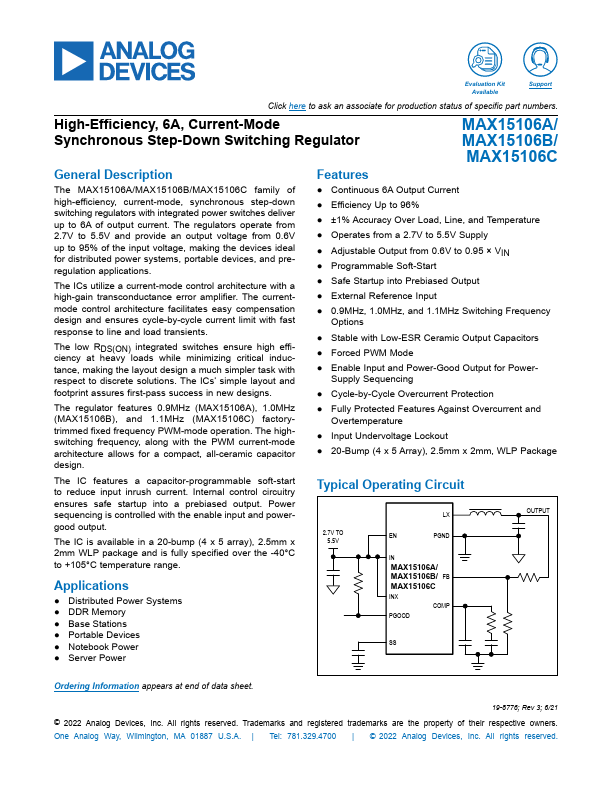
The MAX15106A/MAX15106B/MAX15106C family of high-efficiency, current-mode, synchronous step-down switching regulators with integrated power switches deliver up to 6A of output current.

Key Features

  • 0.9MHz (MAX15106A), 1.0MHz (MAX15106B), and 1.1MHz (MAX15106C) factorytrimmed fixed frequency PWM-mode operation. The highswitching frequency, along with the PWM current-mode architecture allows for a compact, all-ceramic capacitor design. Features.
  • Continuous 6A Output Current.
  • Efficiency Up to 96%.
  • ±1% Accuracy Over Load, Line, and Temperature.
  • Operates from a 2.7V to 5.5V Supply.
  • Adjustable Output from 0.6V to 0.95 × VIN.
  • Programmable Soft-Start.
  • Safe Start.

📥 Download Datasheet

Note: The manufacturer provides a single datasheet file (MAX15106A-AnalogDevices.pdf) that lists specifications for multiple related part numbers.

Full PDF Text Transcription (Reference)

The following content is an automatically extracted verbatim text from the original manufacturer datasheet and is provided for reference purposes only.

View original datasheet text
Evaluation Kit Available Support Click here to ask an associate for production status of specific part numbers. High-Efficiency, 6A, Current-Mode Synchronous Step-Down Switching Regulator MAX15106A/ MAX15106B/ MAX15106C General Description The MAX15106A/MAX15106B/MAX15106C family of high-efficiency, current-mode, synchronous step-down switching regulators with integrated power switches deliver up to 6A of output current. The regulators operate from 2.7V to 5.5V and provide an output voltage from 0.6V up to 95% of the input voltage, making the devices ideal for distributed power systems, portable devices, and preregulation applications. The ICs utilize a current-mode control architecture with a high-gain transconductance error amplifier.