ASD5020
ASD5020 is High Speed Mode Multi-Mode 12-bit 640 MSPS / 8-bit 1000 MSPS Analog to Digital Converter manufactured by Arctic Silicon Devices.
Preliminary Product Specification
ASD5020 High Speed Mode
Multi-Mode 12-bit 640 MSPS / 8-bit 1000 MSPS Analog to Digital Converter Features
- 12-bit Modes
- Single Channel Mode: FSmax = 640 MSPS
- Dual Channel Mode: FSmax = 320 MSPS
- Quad Channel Mode: FSmax = 160 MSPS
- SNR: 71 d B, SFDR: 65 d B 8-bit Modes
- Single Channel Mode: FSmax = 1000 MSPS
- Dual Channel Mode: FSmax = 500 MSPS
- Quad Channel Mode: FSmax = 250 MSPS
- SNR: 49 d B, SFDR: 65 d B Integrated Cross Point Switches with instantaneous switching Internal low jitter programmable Clock Divider Ultra Low Power Dissipation
- 490m W including I/O at 640 MSPS 0.5 µs start-up time from Sleep, 15 µs from Power Down Internal reference circuitry with no external ponents required Coarse and fine gain control Digital fine gain adjustment for each ADC Internal offset correction 1.8 V supply voltage 1.7
- 3.6 V CMOS logic on control interface pins Serial LVDS/RSDS output
- 12, 14, 16 and Dual 8-bit modes available 7mm x 7mm 48 QFN Package
Description
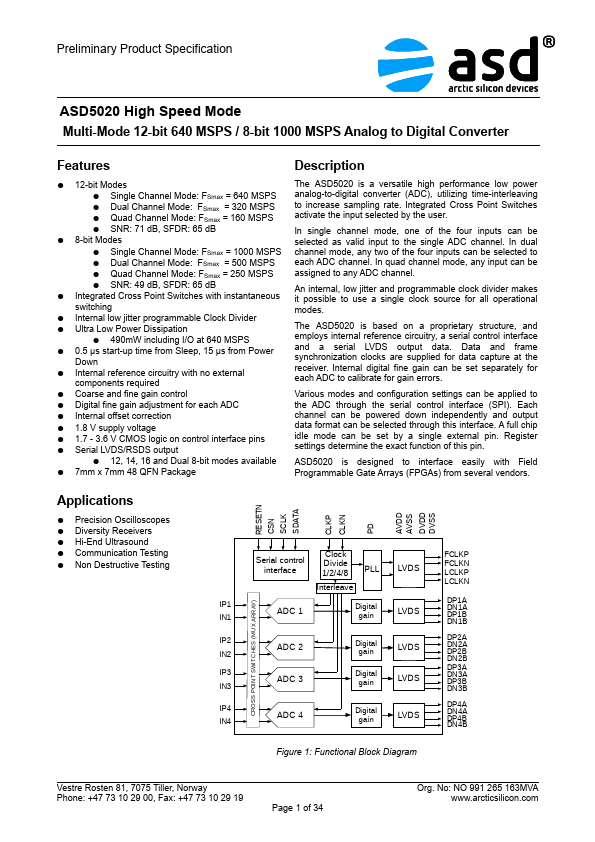
The ASD5020 is a versatile high performance low power analog-to-digital converter (ADC), utilizing time-interleaving to increase sampling rate. Integrated Cross Point Switches activate the input selected by the user. In single channel mode, one of the four inputs can be selected as valid input to the single ADC channel. In dual channel mode, any two of the four inputs can be selected to each ADC channel. In quad channel mode, any input can be assigned to any ADC channel. An internal, low jitter and programmable clock divider makes it possible to use a single clock source for all operational modes. The ASD5020 is based on a proprietary structure, and employs internal reference circuitry, a serial control interface and a serial LVDS output data. Data and frame synchronization clocks are supplied for data capture at the receiver. Internal digital fine gain can be set separately for each ADC to calibrate for gain errors. Various modes and configuration settings can be...