Mega-2560
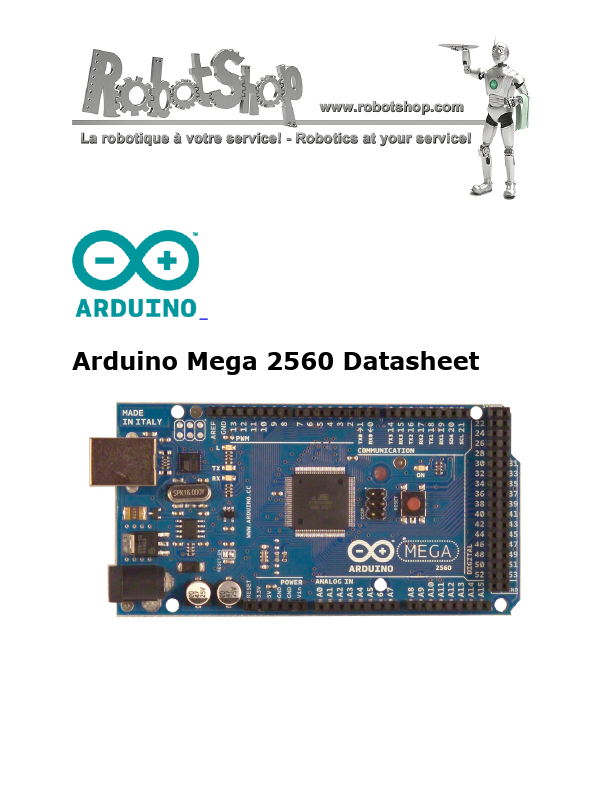
Mega-2560 is microcontroller board manufactured by Arduino.
Overview
The Arduino Mega 2560 is a microcontroller board based on the ATmega2560 (datasheet). It has 54 digital input/output pins (of which 14 can be used as PWM outputs), 16 analog inputs, 4 UARTs (hardware serial ports), a 16 MHz crystal oscillator, a USB connection, a power jack, an ICSP header, and a reset button. It contains everything needed to support the microcontroller; simply connect it to a puter with a USB cable or power it with a ACto-DC adapter or battery to get started. The Mega is patible with most shields designed for the Arduino Duemilanove or Diecimila.
Schematic & Reference Design
EAGLE files: arduino-mega2560-reference-design.zip
Schematic: arduino-mega2560-schematic.pdf
Summary
Microcontroller Operating Voltage Input Voltage (remended) Input Voltage (limits) Digital I/O Pins Analog Input Pins DC Current per I/O Pin DC Current for 3.3V Pin Flash Memory SRAM EEPROM Clock Speed
ATmega2560 5V 7-12V 6-20V 54 (of which 14 provide PWM output) 16 40 m A 50 m A 256 KB of which 8 KB used by bootloader 8 KB 4 KB 16 MHz
Power
The Arduino Mega can be powered via the USB connection or with an external power supply. The power source is selected automatically.
External (non-USB) power can e either from an AC-to-DC adapter (wall-wart) or battery. The adapter can be connected by plugging a 2.1mm center-positive plug into the board's power jack. Leads from a battery can be inserted in the Gnd and Vin pin headers of the POWER connector.
The board can operate on an external supply of 6 to 20 volts. If supplied with less than 7V, however, the 5V pin may supply less than five volts and the board may be unstable. If using more than 12V, the voltage regulator may overheat and damage the board. The remended range is 7 to 12 volts.
The Mega2560 differs from all preceding boards in that it does not use the FTDI USB-toserial driver chip. Instead, it features the Atmega8U2 programmed as a USB-to-serial converter.
The power pins are as follows:
- VIN. The input...