Datasheet4U Logo Datasheet4U.com

MGA-14516 - High Linearity Active Bias Low Noise Amplifier

General Description

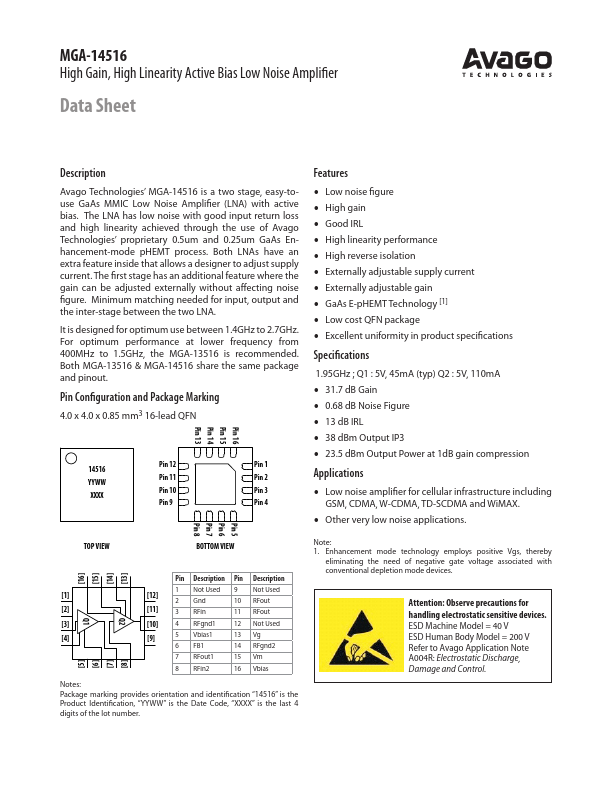
Avago Technologies’ MGA-14516 is a two stage, easy-touse GaAs MMIC Low Noise Amplifier (LNA) with active bias.

The LNA has low noise with good input return loss and high linearity achieved through the use of Avago Technologies’ proprietary 0.5um and 0.25um GaAs Enhancement-mode pHEMT process.

Key Features

  • Low noise figure.
  • High gain.
  • Good IRL.
  • High linearity performance.
  • High reverse isolation.
  • Externally adjustable supply current.
  • Externally adjustable gain.
  • GaAs E-pHEMT Technology [1].
  • Low cost QFN package.
  • Excellent uniformity in product specifications Specifications  1.95GHz ; Q1 : 5V, 45mA (typ) Q2 : 5V, 110mA.
  • 31.7 dB Gain.
  • 0.68 dB Noise Figure.
  • 13 dB IRL.

📥 Download Datasheet

Datasheet Details

Part number MGA-14516
Manufacturer Avago Technologies
File Size 464.10 KB
Description High Linearity Active Bias Low Noise Amplifier
Datasheet download datasheet MGA-14516 Datasheet

Full PDF Text Transcription (Reference)

The following content is an automatically extracted verbatim text from the original manufacturer datasheet and is provided for reference purposes only.

View original datasheet text
MGA-14516 High Gain, High Linearity Active Bias Low Noise Amplifier Data Sheet Description Avago Technologies’ MGA-14516 is a two stage, easy-touse GaAs MMIC Low Noise Amplifier (LNA) with active bias. The LNA has low noise with good input return loss and high linearity achieved through the use of Avago Technologies’ proprietary 0.5um and 0.25um GaAs Enhancement-mode pHEMT process. Both LNAs have an extra feature inside that allows a designer to adjust supply current. The first stage has an additional feature where the gain can be adjusted externally without affecting noise figure. Minimum matching needed for input, output and the inter-stage between the two LNA. It is designed for optimum use between 1.4GHz to 2.7GHz. For optimum performance at lower frequency from 400MHz to 1.