Datasheet4U Logo Datasheet4U.com

HCPL-7800 - Isolation Amplifer

Download the HCPL-7800 datasheet PDF. This datasheet also covers the HCPL-7800A variant, as both devices belong to the same isolation amplifer family and are provided as variant models within a single manufacturer datasheet.

General Description

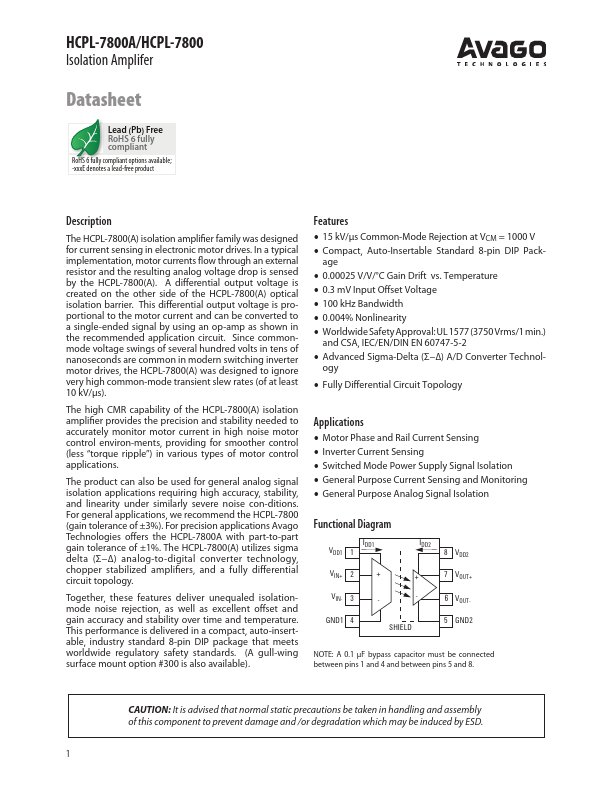
The HCPL-7800(A) isolation amplifier family was designed for current sensing in electronic motor drives.

In a typical implementation, motor currents flow through an external resistor and the resulting analog voltage drop is sensed by the HCPL-7800(A).

Key Features

  • deliver unequaled isolationmode noise rejection, as well as excellent offset and gain accuracy and stability over time and temperature. This performance is delivered in a compact, auto-insertable, industry standard 8-pin DIP package that meets worldwide regulatory safety standards. (A gull-wing surface mount option #300 is also available). Features.
  • 15 kV/µs Common-Mode Rejection at VCM = 1000 V.
  • Compact, Auto-Insertable Standard 8-pin DIP Pack- age.
  • 0.00025 V/V/°C.

📥 Download Datasheet

Note: The manufacturer provides a single datasheet file (HCPL-7800A-Avago.pdf) that lists specifications for multiple related part numbers.

Full PDF Text Transcription (Reference)

The following content is an automatically extracted verbatim text from the original manufacturer datasheet and is provided for reference purposes only.

View original datasheet text
HCPL-7800A/HCPL-7800 Isolation Amplifer Datasheet Lead (Pb) Free RoHS 6 fully compliant RoHS 6 fully compliant options available; -xxxE denotes a lead-free product Description The HCPL-7800(A) isolation amplifier family was designed for current sensing in electronic motor drives. In a typical implementation, motor currents flow through an external resistor and the resulting analog voltage drop is sensed by the HCPL-7800(A). A differential output voltage is created on the other side of the HCPL-7800(A) optical isolation barrier. This differential output voltage is proportional to the motor current and can be converted to a single-ended signal by using an op-amp as shown in the recommended application circuit.