
• Part: ALC100
  • Description: Crystal Requirement
  • Manufacturer: Avance Logic
  • Size: 47.77 KB
Download ALC100 Datasheet PDF
Avance Logic
ALC100
ALC100 is Crystal Requirement manufactured by Avance Logic.
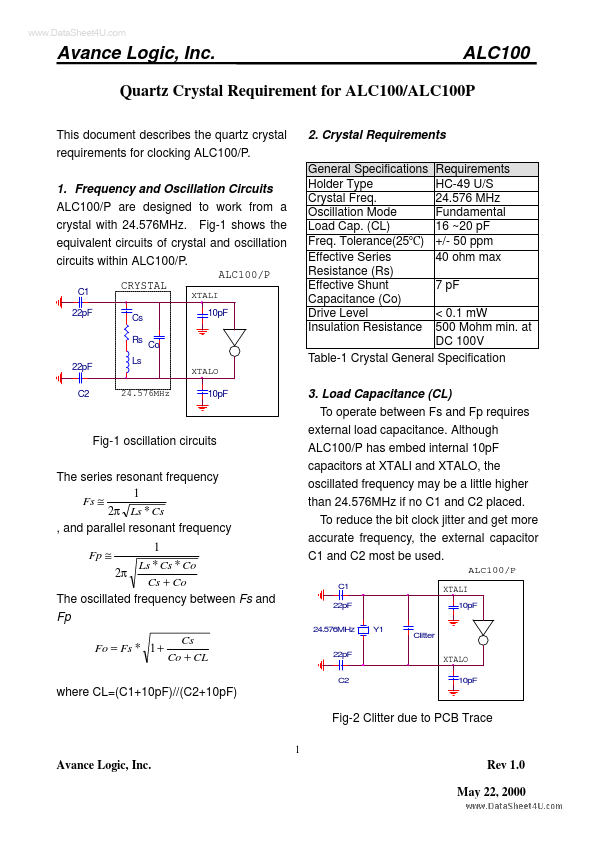
.. Avance Logic, Inc. Quartz Crystal Requirement for ALC100/ALC100P This document describes the quartz crystal requirements for clocking ALC100/P. 1. Frequency and Oscillation Circuits ALC100/P are designed to work from a crystal with 24.576MHz. Fig-1 shows the equivalent circuits of crystal and oscillation circuits within ALC100/P. ALC100/P C1 22p F 2. Crystal Requirements General Specifications Holder Type Crystal Freq. Oscillation Mode Load Cap. (CL) Freq. Tolerance(25o C) Effective Series Resistance (Rs) Effective Shunt Capacitance (Co) Drive Level Insulation Resistance Requirements HC-49 U/S 24.576 MHz Fundamental 16 ~20 p F +/- 50 ppm 40 ohm max 7 p F CRYSTAL XTALI Cs Rs Co XTALO 24.576MHz 10p F 10p F 22p F C2 Ls < 0.1 m W 500 Mohm min. at DC 100V Table-1 Crystal General Specification 3. Load Capacitance (CL) To operate between Fs and Fp requires external load capacitance. Although ALC100/P has embed internal 10p F capacitors at XTALI and XTALO, the oscillated frequency may be a little higher than 24.576MHz if no C1 and C2 placed. To reduce the bit clock jitter and get more accurate frequency, the external capacitor C1 and C2 most be used. ALC100/P C1 22p F 24.576MHz Y1 XTALI 10p F Fig-1 oscillation circuits The series resonant frequency 1 Fs ≅ 2π Ls - Cs , and parallel resonant frequency Ls - Cs - Co Cs + Co The oscillated frequency between Fs and Fp 2π Cs Fo = Fs - 1 + Co + CL where CL=(C1+10p F)//(C2+10p F) Fp ≅ 1 Clitter XTALO 10p F 22p F C2 Fig-2 Clitter due to PCB Trace Avance Logic, Inc. Rev 1.0 May 22, 2000 .. Avance Logic, Inc. In ideal case, ignore the Clitter at suggested C1=C2=22p F, the equivalent load capacitance is CL = (22 p F + 10 p F ) //(22 p F + 10 p F ) = 16 p F According to Table-1 specification, the crystal with CL is 16p F is adapted. But in most case, the litter capacitor (Clitter) generated by PCB trace is existent. So the real CL is CL = (C1 + 10 p F ) //(C 2 + 10 p F ) + Clitter Consider the...