

Datasheet4U Logo Datasheet4U.com

ADS8509 - 16-BIT 250-KSPS SERIAL CMOS SAMPLING ANALOG-TO-DIGITAL CONVERTER

This page provides the datasheet information for the ADS8509, a member of the ADS8509_Burr 16-BIT 250-KSPS SERIAL CMOS SAMPLING ANALOG-TO-DIGITAL CONVERTER family.

Description

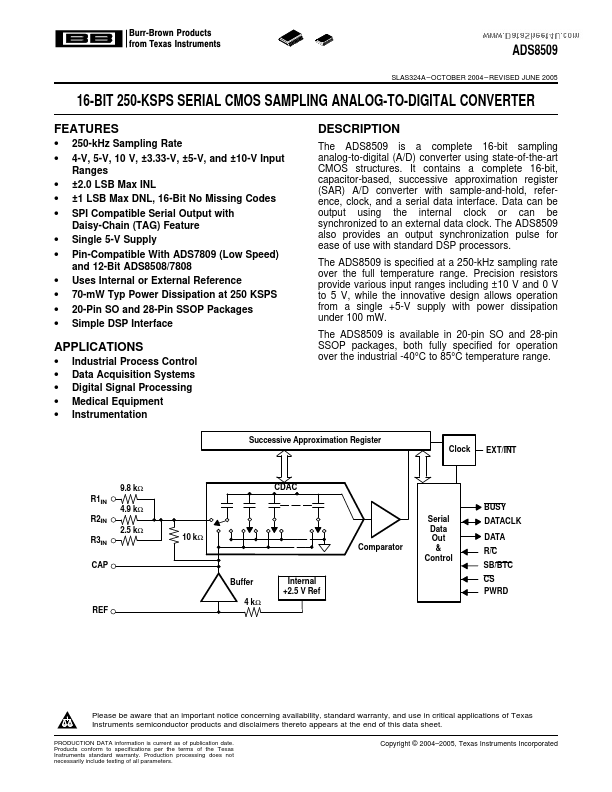
The ADS8509 is a complete 16-bit sampling analog-to-digital (A/D) converter using state-of-the-art CMOS structures.

It contains a complete 16-bit, capacitor-based, successive approximation register (SAR) A/D converter with sample-and-hold, reference, clock, and a serial data interface.
Features

  • 250-kHz Sampling Rate 4-V, 5-V, 10 V, ±3.33-V, ±5-V, and ±10-V Input Ranges ±2.0 LSB Max INL ±1 LSB Max DNL, 16-Bit No Missing Codes SPI Compatible Serial Output with Daisy-Chain (TAG) Feature Single 5-V Supply Pin-Compatible With ADS7809 (Low Speed) and 12-Bit ADS8508/7808 Uses Internal or External Reference 70-mW Typ Power Dissipation a.

📥 Download Datasheet

Datasheet preview – ADS8509

Datasheet Details

Part number ADS8509
Manufacturer Burr-Brown Corporation
File Size 734.12 KB
Description 16-BIT 250-KSPS SERIAL CMOS SAMPLING ANALOG-TO-DIGITAL CONVERTER
Datasheet download datasheet ADS8509 Datasheet
Additional preview pages of the ADS8509 datasheet.
Other Datasheets by Burr-Brown Corporation

Full PDF Text Transcription

Click to expand full text
BurrĆBrown Products from Texas Instruments ADS8509 SLAS324A – OCTOBER 2004 – REVISED JUNE 2005 16-BIT 250-KSPS SERIAL CMOS SAMPLING ANALOG-TO-DIGITAL CONVERTER FEATURES • • • • • • • • • • • • • • • • 250-kHz Sampling Rate 4-V, 5-V, 10 V, ±3.33-V, ±5-V, and ±10-V Input Ranges ±2.0 LSB Max INL ±1 LSB Max DNL, 16-Bit No Missing Codes SPI Compatible Serial Output with Daisy-Chain (TAG) Feature Single 5-V Supply Pin-Compatible With ADS7809 (Low Speed) and 12-Bit ADS8508/7808 Uses Internal or External Reference 70-mW Typ Power Dissipation at 250 KSPS 20-Pin SO and 28-Pin SSOP Packages Simple DSP Interface DESCRIPTION The ADS8509 is a complete 16-bit sampling analog-to-digital (A/D) converter using state-of-the-art CMOS structures.
Published: |