CHR-UM6
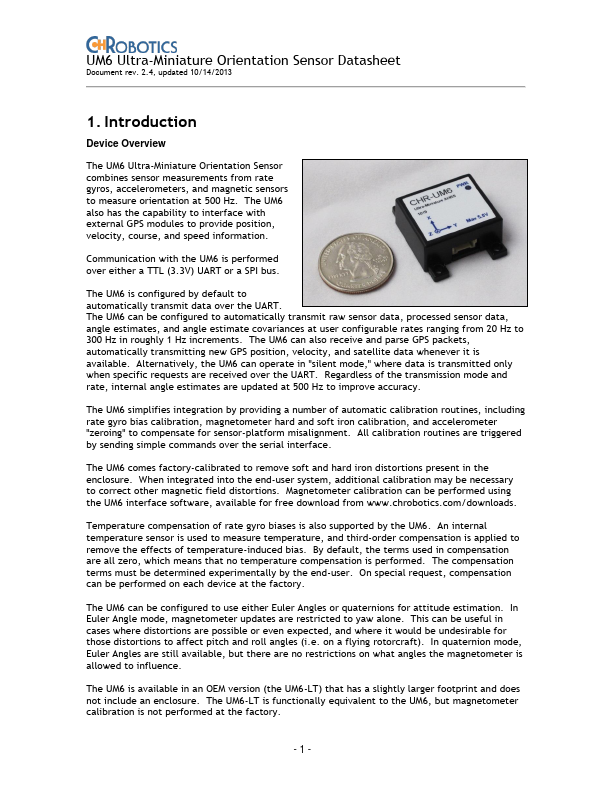
CHR-UM6 is Ultra-Miniature Orientation Sensor manufactured by CH Robotics.
Overview
The UM6 Ultra-Miniature Orientation Sensor bines sensor measurements from rate gyros, accelerometers, and magnetic sensors to measure orientation at 500 Hz. The UM6 also has the capability to interface with external GPS modules to provide position, velocity, course, and speed information. munication with the UM6 is performed over either a TTL (3.3V) UART or a SPI bus.
The UM6 is configured by default to automatically transmit data over the UART. The UM6 can be configured to automatically transmit raw sensor data, processed sensor data, angle estimates, and angle estimate covariances at user configurable rates ranging from 20 Hz to 300 Hz in roughly 1 Hz increments. The UM6 can also receive and parse GPS packets, automatically transmitting new GPS position, velocity, and satellite data whenever it is available. Alternatively, the UM6 can operate in "silent mode," where data is transmitted only when specific requests are received over the UART. Regardless of the transmission mode and rate, internal angle estimates are updated at 500 Hz to improve accuracy.
The UM6 simplifies integration by providing a number of automatic calibration routines, including rate gyro bias calibration, magnetometer hard and soft iron calibration, and accelerometer "zeroing" to pensate for sensor-platform misalignment. All calibration routines are triggered by sending simple mands over the serial interface.
The UM6 es factory-calibrated to remove soft and hard iron distortions present in the enclosure. When integrated into the end-user system, additional calibration may be necessary to correct other magnetic field distortions. Magnetometer calibration can be performed using the UM6 interface software, available for free download from .chrobotics./downloads.
Temperature pensation of rate gyro biases is also supported by the UM6. An internal temperature sensor is used to measure temperature, and third-order pensation is applied to remove the effects of temperature-induced bias. By...