CP2160
CP2160 is 1X/1.5X Common Cathode Adaptive Charge Pump Parallel LED Driver manufactured by CHIP.
Product Brief
CP2160 V1.0
LED Driver Series
6 Channel, 1X/1.5X mon Cathode Adaptive Charge Pump Parallel LED Driver with 1-Wire Pulse Counting Dimming Control
..
General Description
The CP2160, a 1X/1.5X mon cathode adaptive charge pump parallel LED driver, is ideally suited for all applications powered by a single LI-Ion battery cell with input voltage varying between 2.7V to 5.5V. The CP2160 provides up to 25m A LED current per channel, set by an internal resistor. High efficiency is achieved by utilizing a 1x/1.5x adaptive fractional conversion technique based on the supply voltage and the output voltage. The unique Auto-Mirror TM technology is introduced in CP2160, which can guarantee a constant LED current in various operating conditions. The CP2160 uses the 1-wire pulse counting technique to adjust the brightness of LEDs, with the pulse signal on the EN/SET pin, the LED current varies according to 32 steps logarithmic scale. Only two 1µF input/output capacitors and two 1µF pump capacitors are needed for proper operation. The superior architecture ensures low inrush current and low EMI. The CP2160 adopts QFN 3- 3 16L package.
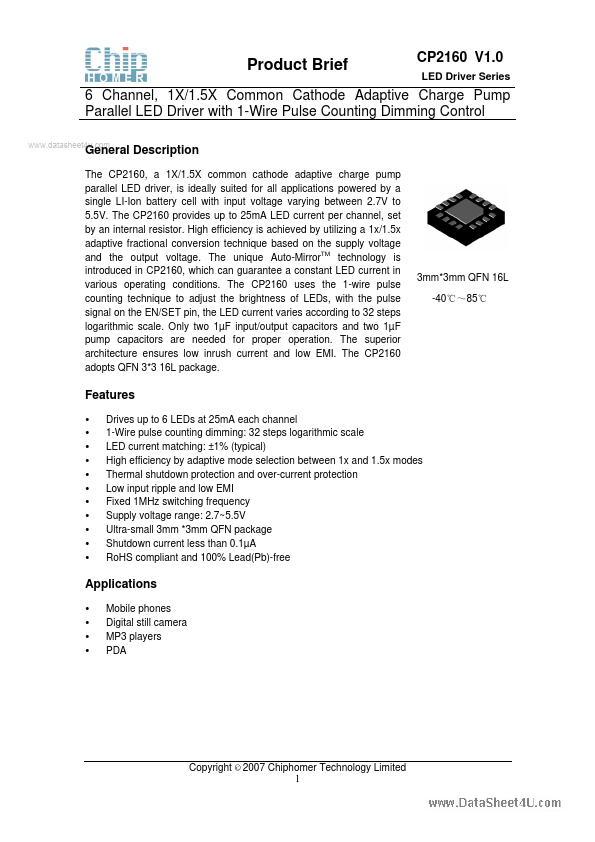
3mm- 3mm QFN 16L -40℃~85℃
Features y y y y y y y y y y y Drives up to 6 LEDs at 25m A each channel 1-Wire pulse counting dimming: 32 steps logarithmic scale LED current matching: ±1% (typical) High efficiency by adaptive mode selection between 1x and 1.5x modes Thermal shutdown protection and over-current protection Low input ripple and low EMI Fixed 1MHz switching frequency Supply voltage range: 2.7~5.5V Ultra-small 3mm
- 3mm QFN package Shutdown current less than 0.1µA Ro HS pliant and 100% Lead(Pb)-free
Applications y y y y Mobile phones Digital still camera MP3 players PDA
Copyright © 2007 Chiphomer Technology Limited 1
Product Brief
CP2160 V1.0
LED Driver Series
6 Channel, 1X/1.5X mon Cathode Adaptive Charge Pump Parallel LED Driver with 1-Wire Pulse Counting Dimming Control
..
Pin...