Datasheet4U Logo Datasheet4U.com

KTLP165J - 4PIN MINI-FLAT RANDOM-PHASE TRIAC DRIVER PHOTOCOUPLER

General Description

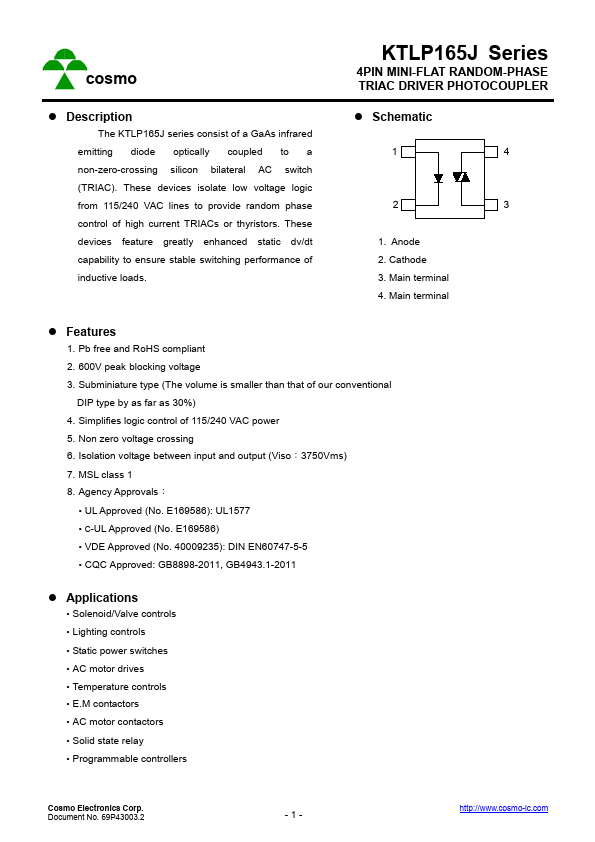
The KTLP165J series consist of a GaAs infrared emitting diode optically coupled to a non-zero-crossing silicon bilateral AC switch (TRIAC).

These devices isolate low voltage logic from 115/240 VAC lines to provide random phase control of high current TRIACs or thyristors.

Key Features

  • s 1. Pb free and RoHS compliant 2. 600V peak blocking voltage 3. Subminiature type (The volume is smaller than that of our conventional DIP type by as far as 30%) 4. Simplifies logic control of 115/240 VAC power 5. Non zero voltage crossing 6. Isolation voltage between input and output (Viso:3750Vms) 7. MSL class 1 8. Agency Approvals:.
  • UL Approved (No. E169586): UL1577.
  • C-UL Approved (No. E169586).
  • VDE App.

📥 Download Datasheet

Datasheet Details

Part number KTLP165J
Manufacturer COSMO Electronics Corporation
File Size 199.54 KB
Description 4PIN MINI-FLAT RANDOM-PHASE TRIAC DRIVER PHOTOCOUPLER
Datasheet download datasheet KTLP165J Datasheet

Full PDF Text Transcription for KTLP165J (Reference)

Note: Below is a high-fidelity text extraction (approx. 800 characters) for KTLP165J. For precise diagrams, and layout, please refer to the original PDF.

cosmo  Description The KTLP165J series consist of a GaAs infrared emitting diode optically coupled to a non-zero-crossing silicon bilateral AC switch (TRIAC). These devi...

View more extracted text
to a non-zero-crossing silicon bilateral AC switch (TRIAC). These devices isolate low voltage logic from 115/240 VAC lines to provide random phase control of high current TRIACs or thyristors. These devices feature greatly enhanced static dv/dt capability to ensure stable switching performance of inductive loads. KTLP165J Series 4PIN MINI-FLAT RANDOM-PHASE TRIAC DRIVER PHOTOCOUPLER  Schematic 14 2 1. Anode 2. Cathode 3. Main terminal 4. Main terminal 3  Features 1. Pb free and RoHS compliant 2. 600V peak blocking voltage 3. Subminiature type (The volume is smaller than that of our conventional DIP type by as far as 30%)