CS5207-1
CS5207-1 is 7A Adjustable Linear Regulator manufactured by Cherry Semiconductor Corporation.
Description
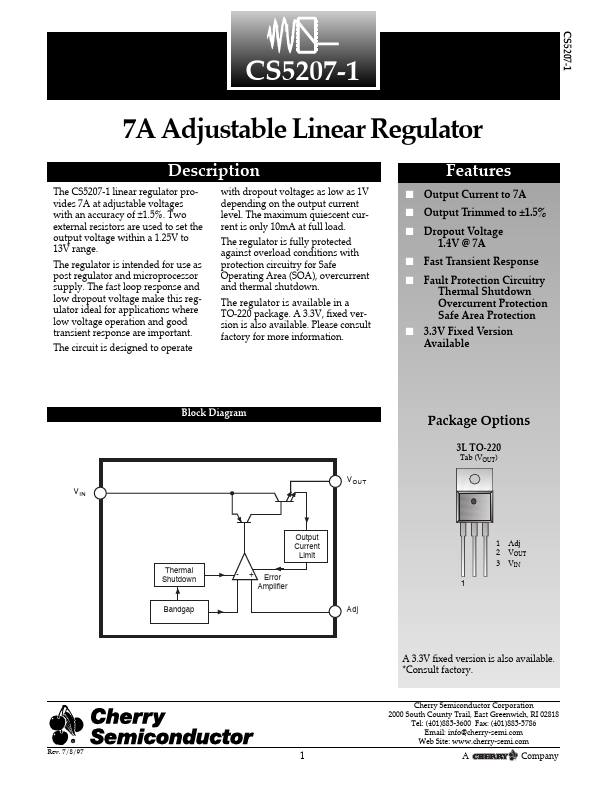
The CS5207-1 linear regulator provides 7A at adjustable voltages with an accuracy of ±1.5%. Two external resistors are used to set the output voltage within a 1.25V to 13V range. The regulator is intended for use as post regulator and microprocessor supply. The fast loop response and low dropout voltage make this regulator ideal for applications where low voltage operation and good transient response are important. The circuit is designed to operate with dropout voltages as low as 1V depending on the output current level. The maximum quiescent current is only 10m A at full load. The regulator is fully protected against overload conditions with protection circuitry for Safe Operating Area (SOA), overcurrent and thermal shutdown. The regulator is available in a TO-220 package. A 3.3V, fixed version is also available. Please consult factory for more information.
Features s Output Current to 7A s Output Trimmed to ±1.5% s Dropout Voltage 1.4V @ 7A s Fast Transient Response s Fault Protection Circuitry Thermal Shutdown Overcurrent Protection Safe Area Protection s 3.3V Fixed Version Available
Block Diagram
Package Options
3L TO-220
Tab (VOUT)
V OUT V IN
Output Current Limit Thermal Shutdown + Error Amplifier Adj
1 2 3
Adj VOUT VIN
Bandgap
A 3.3V fixed version is also available.
- Consult factory.
Cherry Semiconductor Corporation 2000 South County Trail, East Greenwich, RI 02818 Tel: (401)885-3600 Fax: (401)885-5786 Email: info@cherry-semi. Web Site: .cherry-semi.
Rev. 7/8/97
¨ pany
CS5207 -1
Absolute Maximum Ratings Supply Voltage, VCC 17V Operating Temperature Range -40¡C to 70¡C Junction Temperature...