Datasheet4U Logo Datasheet4U.com

CS8122 - 2% 5V 750mA Low Dropout Linear Regulator

General Description

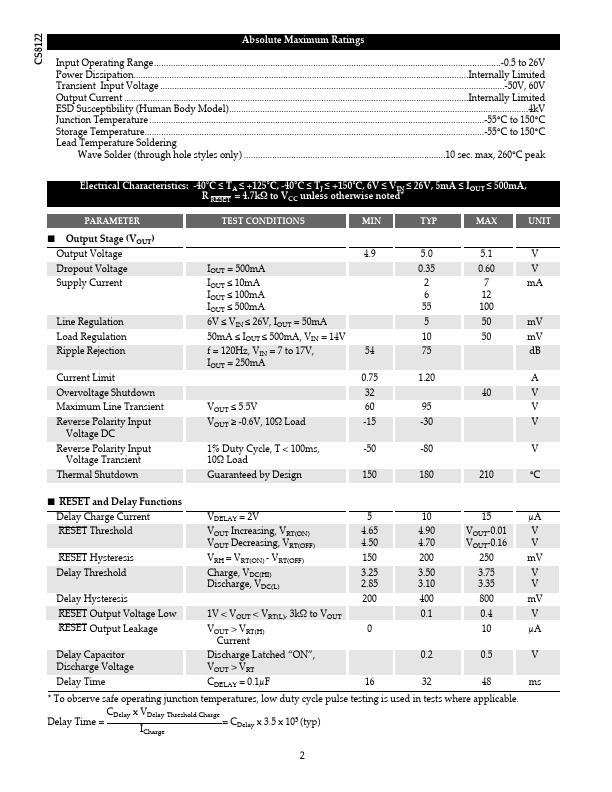
The CS8122 is a precision 5V linear regulator capable of sourcing in excess of 750mA.

The RESET Õs delay time is externally programmed using a discrete RC network.

During power up, or when the output goes out of regulation, the RESET lead remains in the low state for the duration of the delay.

Key Features

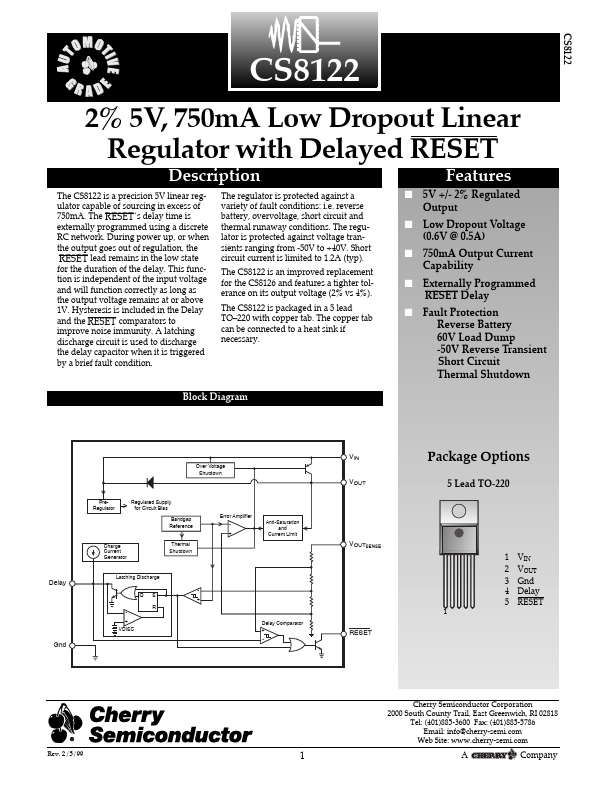
  • a tighter tolerance on its output voltage (2% vs 4%). The CS8122 is packaged in a 5 lead TOÐ220 with copper tab. The copper tab can be connected to a heat sink if necessary. Features s 5V +/- 2% Regulated Output s Low Dropout Voltage (0.6V @ 0.5A) s 750mA Output Current Capability s Externally Programmed RESET Delay s Fault Protection Reverse Battery 60V Load Dump -50V Reverse Transient Short Circuit Thermal Shutdown Block Diagram VIN Over Voltage Shutdown Package Options 5 Lead TO-220 VOUT.

📥 Download Datasheet

Datasheet Details

Part number CS8122
Manufacturer Cherry Semiconductor Corporation
File Size 175.20 KB
Description 2% 5V 750mA Low Dropout Linear Regulator
Datasheet download datasheet CS8122 Datasheet

Full PDF Text Transcription (Reference)

The following content is an automatically extracted verbatim text from the original manufacturer datasheet and is provided for reference purposes only.

View original datasheet text
CS8122 CS8122 2% 5V, 750mA Low Dropout Linear Regulator with Delayed RESET Description The CS8122 is a precision 5V linear regulator capable of sourcing in excess of 750mA. The RESET Õs delay time is externally programmed using a discrete RC network. During power up, or when the output goes out of regulation, the RESET lead remains in the low state for the duration of the delay. This function is independent of the input voltage and will function correctly as long as the output voltage remains at or above 1V. Hysteresis is included in the Delay and the RESET comparators to improve noise immunity. A latching discharge circuit is used to discharge the delay capacitor when it is triggered by a brief fault condition. The regulator is protected against a variety of fault conditions: i.e.