CS8271
CS8271 is Adjustable Micropower Low Dropout Linear Regulator with ENABLE manufactured by Cherry Semiconductor Corporation.
Description
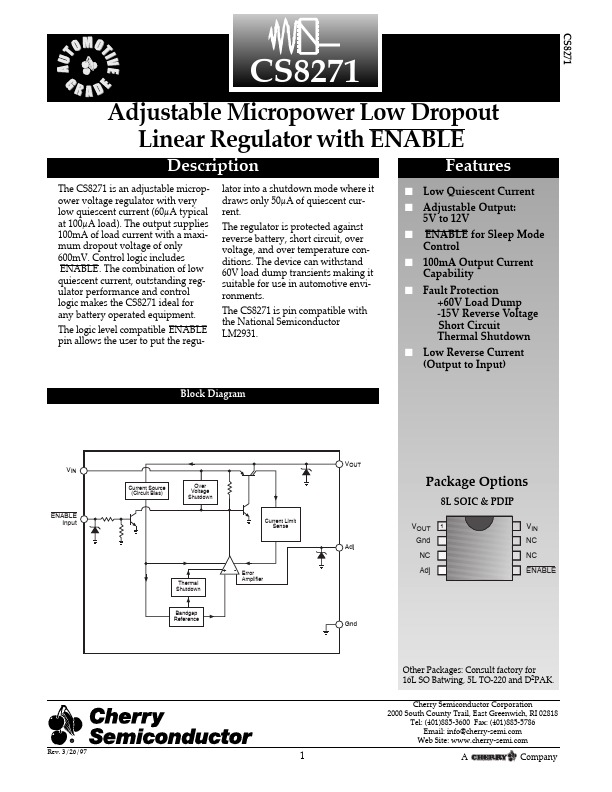
The CS8271 is an adjustable micropower voltage regulator with very low quiescent current (60µA typical at 100µA load). The output supplies 100m A of load current with a maximum dropout voltage of only 600m V. Control logic includes ENABLE . The bination of low quiescent current, outstanding regulator performance and control logic makes the CS8271 ideal for any battery operated equipment. The logic level patible ENABLE pin allows the user to put the regulator into a shutdown mode where it draws only 50µA of quiescent current. The regulator is protected against reverse battery, short circuit, over voltage, and over temperature conditions. The device can withstand 60V load dump transients making it suitable for use in automotive environments. The CS8271 is pin patible with the National Semiconductor LM2931.
Features s Low Quiescent Current s Adjustable Output: 5V to 12V s ENABLE for Sleep Mode Control s 100m A Output Current Capability s Fault Protection +60V Load Dump -15V Reverse Voltage Short Circuit Thermal Shutdown s Low Reverse Current (Output to Input)
Block Diagram
Current Source (Circuit Bias) Over Voltage Shutdown
VOUT
Package Options
8L SOIC & PDIP
Current Limit Sense
ENABLE Input
VOUT
Adj
VIN NC NC ENABLE
Gnd NC
+
Thermal Shutdown
- Error
Amplifier
Adj
Bandgap Reference
Gnd
Other Packages: Consult factory for 16L SO Batwing, 5L TO-220 and D2PAK.
Cherry Semiconductor Corporation 2000 South County Trail, East Greenwich, RI 02818 Tel: (401)885-3600 Fax: (401)885-5786 Email: info@cherry-semi. Web Site: .cherry-semi.
Rev. 3/26/97
¨ pany
Absolute Maximum Ratings Power Dissipation Internally Limited Transient Input Voltage -50V, 60V...