


Datasheet4U Logo Datasheet4U.com

CS8441 - 85mA Dual H-Bridge Odometer Driver with Divide by Select

Datasheet Summary

Description

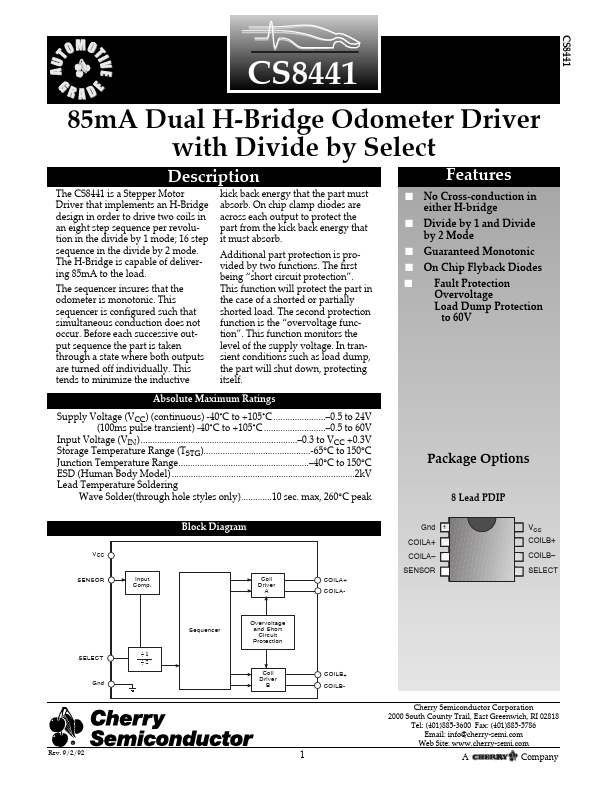
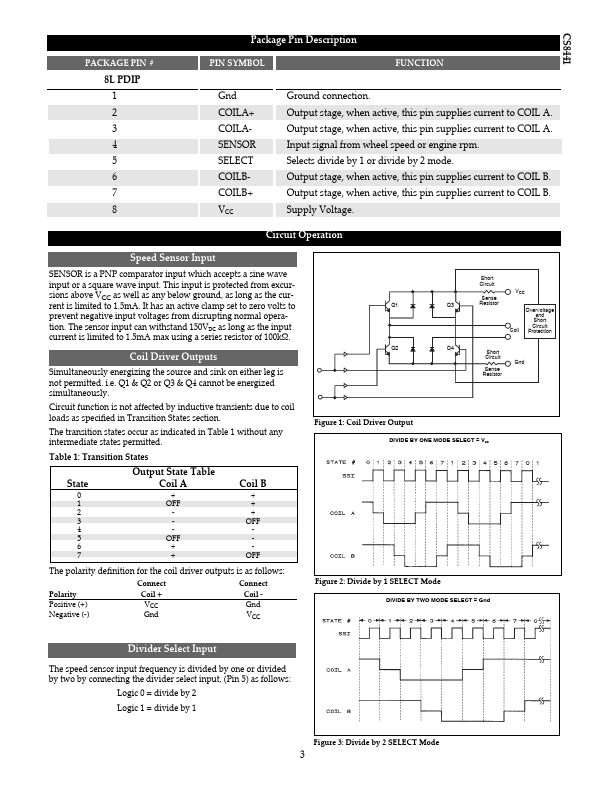
The CS8441 is a Stepper Motor Driver that implements an H-Bridge design in order to drive two coils in an eight step sequence per revolution in the divide by 1 mode; 16 step sequence in the divide by 2 mode.

The H-Bridge is capable of delivering 85mA to the load.

Features

  • s No Cross-conduction in either H-bridge s Divide by 1 and Divide by 2 Mode s Guaranteed Monotonic s On Chip Flyback Diodes s Fault Protection Overvoltage Load Dump Protection to 60V Absolute Maximum Ratings Supply Voltage (VCC) (continuous) -40ûC to +105ûC Ð0.5 to 24V (100ms pulse transient) -40ûC to +105ûC Ð0.5 to 60V Input Voltage (VIN) Ð0.3 to VCC +0.3V Storage Temperature Range (TSTG)-65¡C to 150¡C Junction Temperature RangeÐ40¡C to 150¡C ESD (Human Body Model) 2kV Lead Temperature Solderi.

📥 Download Datasheet

Datasheet preview – CS8441

Datasheet Details

Part number CS8441
Manufacturer Cherry Semiconductor Corporation
File Size 149.38 KB
Description 85mA Dual H-Bridge Odometer Driver with Divide by Select
Datasheet download datasheet CS8441 Datasheet
Additional preview pages of the CS8441 datasheet.
Other Datasheets by Cherry Semiconductor Corporation

Full PDF Text Transcription

Click to expand full text
CS8441 CS8441 85mA Dual H-Bridge Odometer Driver with Divide by Select Description The CS8441 is a Stepper Motor Driver that implements an H-Bridge design in order to drive two coils in an eight step sequence per revolution in the divide by 1 mode; 16 step sequence in the divide by 2 mode. The H-Bridge is capable of delivering 85mA to the load. The sequencer insures that the odometer is monotonic. This sequencer is configured such that simultaneous conduction does not occur. Before each successive output sequence the part is taken through a state where both outputs are turned off individually. This tends to minimize the inductive kick back energy that the part must absorb. On chip clamp diodes are across each output to protect the part from the kick back energy that it must absorb.
Published: |