

Datasheet4U Logo Datasheet4U.com

CC2420 - First Single-chip 2.4 GHZ Ieee 802.15.4 Compliant And Zigbeetm Ready RF Transceiver

General Description

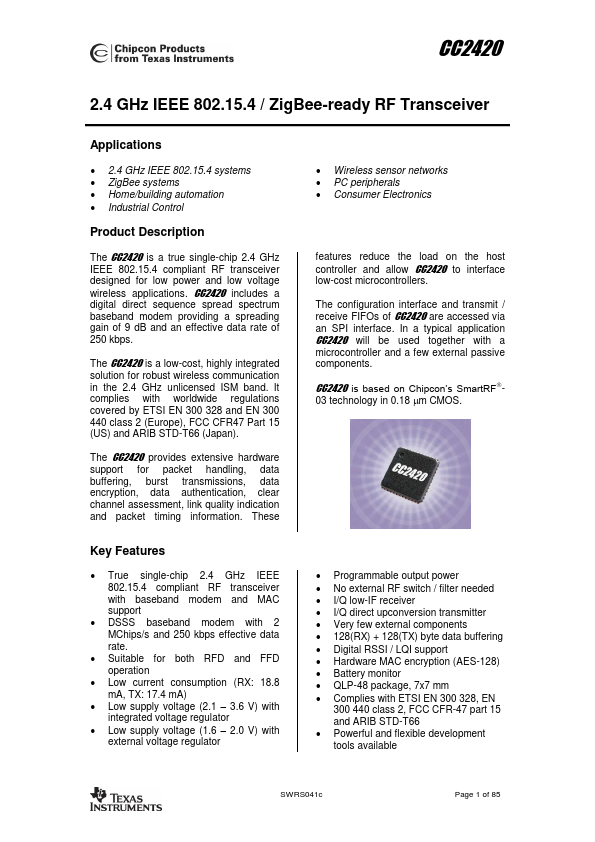
The CC2420 is a true single-chip 2.4 GHz IEEE 802.15.4 compliant RF transceiver designed for low power and low voltage wireless applications.

CC2420 includes a digital direct sequence spread spectrum baseband modem providing a spreading gain of 9 dB and an effective data rate of 250 kbps.

Key Features

  • True single-chip 2.4 GHz IEEE 802.15.4 compliant RF transceiver with baseband modem and MAC support.
  • DSSS baseband modem with 2 MChips/s and 250 kbps effective data rate.
  • Suitable for both RFD and FFD operation.
  • Low current consumption (RX: 18.8 mA, TX: 17.4 mA).
  • Low supply voltage (2.1.
  • 3.6 V) with integrated voltage regulator.
  • Low supply voltage (1.6.
  • 2.0 V) with external voltage regulator.
  • Wireless sensor networks.
  • PC peripherals.

📥 Download Datasheet

Datasheet Details

Part number CC2420
Manufacturer Chipcon
File Size 2.32 MB
Description First Single-chip 2.4 GHZ Ieee 802.15.4 Compliant And Zigbeetm Ready RF Transceiver
Datasheet download datasheet CC2420 Datasheet

Full PDF Text Transcription (Reference)

The following content is an automatically extracted verbatim text from the original manufacturer datasheet and is provided for reference purposes only.

View original datasheet text
CC2420 2.4 GHz IEEE 802.15.4 / ZigBee-ready RF Transceiver Applications  2.4 GHz IEEE 802.15.4 systems  ZigBee systems  Home/building automation  Industrial Control Product Description The CC2420 is a true single-chip 2.4 GHz IEEE 802.15.4 compliant RF transceiver designed for low power and low voltage wireless applications. CC2420 includes a digital direct sequence spread spectrum baseband modem providing a spreading gain of 9 dB and an effective data rate of 250 kbps. The CC2420 is a low-cost, highly integrated solution for robust wireless communication in the 2.4 GHz unlicensed ISM band. It complies with worldwide regulations covered by ETSI EN 300 328 and EN 300 440 class 2 (Europe), FCC CFR47 Part 15 (US) and ARIB STD-T66 (Japan).