Datasheet4U Logo Datasheet4U.com

PLA110S - Single Pole OptoMOS Relays

Download the PLA110S datasheet PDF. This datasheet also covers the PLA110 variant, as both devices belong to the same single pole optomos relays family and are provided as variant models within a single manufacturer datasheet.

General Description

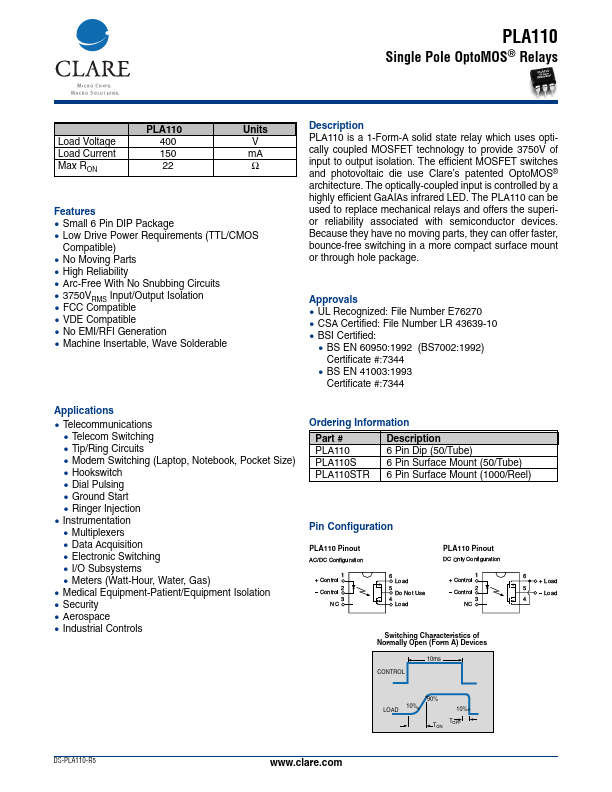
PLA110 is a 1-Form-A solid state relay which uses optically coupled MOSFET technology to provide 3750V of input to output isolation.

The efficient MOSFET switches and photovoltaic die use Clare’s patented OptoMOS® architecture.

Key Features

  • Small 6 Pin DIP Package.
  • Low Drive Power Requirements (TTL/CMOS Compatible).
  • No Moving Parts.
  • High Reliability.
  • Arc-Free With No Snubbing Circuits.
  • 3750VRMS Input/Output Isolation.
  • FCC Compatible.
  • VDE Compatible.
  • No EMI/RFI Generation.
  • Machine Insertable, Wave Solderable.

📥 Download Datasheet

Note: The manufacturer provides a single datasheet file (PLA110-Clare.pdf) that lists specifications for multiple related part numbers.

Datasheet Details

Part number PLA110S
Manufacturer Clare
File Size 476.89 KB
Description Single Pole OptoMOS Relays
Datasheet download datasheet PLA110S Datasheet

Full PDF Text Transcription (Reference)

The following content is an automatically extracted verbatim text from the original manufacturer datasheet and is provided for reference purposes only.

View original datasheet text
PLA110 Single Pole OptoMOS® Relays Load Voltage Load Current Max RON PLA110 400 150 22 Units V mA Ω Features • Small 6 Pin DIP Package • Low Drive Power Requirements (TTL/CMOS Compatible) • No Moving Parts • High Reliability • Arc-Free With No Snubbing Circuits • 3750VRMS Input/Output Isolation • FCC Compatible • VDE Compatible • No EMI/RFI Generation • Machine Insertable, Wave Solderable Description PLA110 is a 1-Form-A solid state relay which uses optically coupled MOSFET technology to provide 3750V of input to output isolation. The efficient MOSFET switches and photovoltaic die use Clare’s patented OptoMOS® architecture. The optically-coupled input is controlled by a highly efficient GaAIAs infrared LED.