

Datasheet4U Logo Datasheet4U.com

CN8380 - integrated quad line interface unit unit for both 1.544 Mbps (T1) and 2.048 Mbps (E1) applications

Datasheet Summary

Description

Information provided by Conexant Systems, Inc.

(Conexant) is believed to be accurate and reliable.

However, no responsibility is assumed by Conexant for its use, nor any infringement of patents or other rights of third parties which may result from its use.

Features

  • Four T1/E1 short haul line interfaces in a single chip.
  • On-chip CLAD /system synchronizer.
  • Digital (crystal-less) jitter attenuators selectable for transmitter/receiver on each line interface.
  • Meets AT&T pub 62411 jitter specs.
  • Meets ITU G.703, ETS 300 011 (PSTNX) Connections.
  • AMI/B8ZS/HDB3 line codes.
  • Host serial port or hardware only control modes.
  • On-chip receive clock recovery.
  • Common transformers for 120/75 Ω.

📥 Download Datasheet

Datasheet preview – CN8380

Datasheet Details

Part number CN8380
Manufacturer Conexant Systems
File Size 921.77 KB
Description integrated quad line interface unit unit for both 1.544 Mbps (T1) and 2.048 Mbps (E1) applications
Datasheet download datasheet CN8380 Datasheet
Additional preview pages of the CN8380 datasheet.
Other Datasheets by Conexant Systems

Full PDF Text Transcription

Click to expand full text
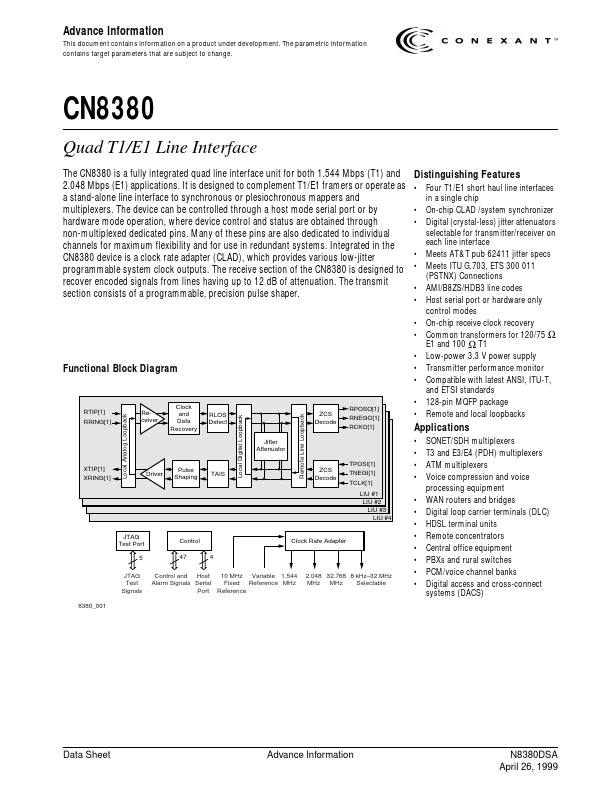
Advance Information This document contains information on a product under development. The parametric information contains target parameters that are subject to change. CN8380 Quad T1/E1 Line Interface The CN8380 is a fully integrated quad line interface unit for both 1.544 Mbps (T1) and 2.048 Mbps (E1) applications. It is designed to complement T1/E1 framers or operate as a stand-alone line interface to synchronous or plesiochronous mappers and multiplexers. The device can be controlled through a host mode serial port or by hardware mode operation, where device control and status are obtained through non-multiplexed dedicated pins. Many of these pins are also dedicated to individual channels for maximum flexibility and for use in redundant systems.
Published: |