STM-S3E
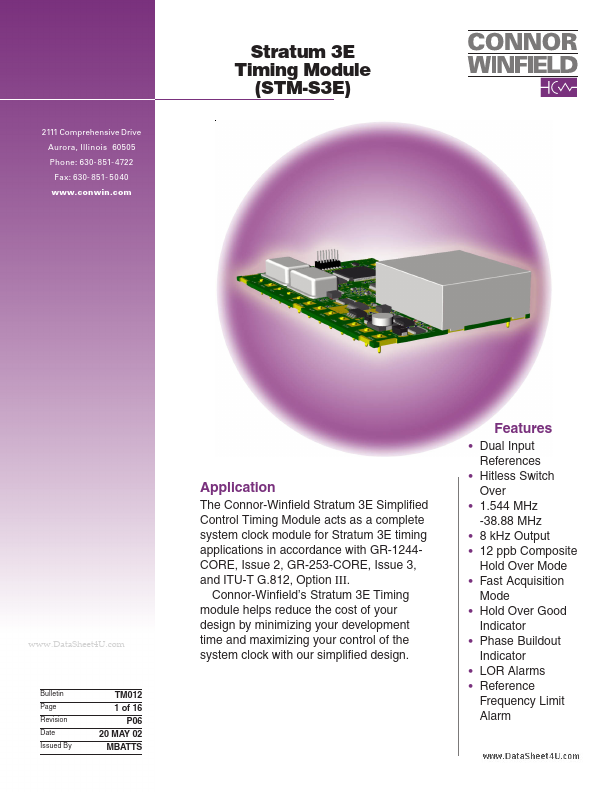
STM-S3E is Stratum 3E Timing Module manufactured by Connor-Winfield.
- Part of the STM-S3E_Connor comparator family.
- Part of the STM-S3E_Connor comparator family.
Stratum 3E Timing Module (STM-S3E)
2111 prehensive Drive Aurora, Illinois 60505 Phone: 630- 851- 4722 Fax: 630- 851- 5040 .conwin.
Features
- Dual Input References
- Hitless Switch Over
- 1.544 MHz -38.88 MHz
- 8 k Hz Output
- 12 ppb posite Hold Over Mode
- Fast Acquisition Mode
- Hold Over Good Indicator
- Phase Buildout Indicator
- LOR Alarms
- Reference Frequency Limit Alarm
Application
The Connor-Winfield Stratum 3E Simplified Control Timing Module acts as a plete system clock module for Stratum 3E timing applications in accordance with GR-1244CORE, Issue 2, GR-253-CORE, Issue 3, and ITU-T G.812, Option ΙΙΙ. Connor-Winfield’s Stratum 3E Timing module helps reduce the cost of your design by minimizing your development time and maximizing your control of the system clock with our simplified design.
..
Bulletin Page Revision Date Issued By
TM012 1 of 16 P06 20 MAY 02 MBATTS
General Description
Connor-Winfield’s STM-S3E timing module provides Stratum 3E synchronization for a plete system clock solution in a single module in accordance with GR-1244CORE Issue 2, GR-253-CORE Issue 3, and ITU-T G.812 Option III. The STM-S3E provides a reliable network element clock reference to line cards used in TDM, PDH, SONET, and SDH application environments. Typical applications include digital cross talks, DSLAMs, ADMs, multiservice platforms, switches and routers. The STM-S3E meets 12 ppb Hold Over requirements over 0°
- 70°C temperature range. The 5V power requirement will draw a maximum of 1.2 A during an initial start-up period and then drop to a typical current of 800 m A during normal operating conditions. It accepts two 8 k Hz input references and can be manufactured to supply a fixed frequency from 1.544 MHz to 38.88 MHz. The STM-S3E offers 4 user selectable modes of operation, Reference 1, Reference 2, Hold Over and Free Run. Mode of operation is selected by two control pins (Table 6). The current mode of operation is also indicated...