CY2254A
CY2254A is Pentium Processor Compatible Clock Synthesizer/Driver manufactured by Cypress.
4A
..
Pentium® Processor patible Clock Synthesizer/Driver
Features
- Multiple clock outputs to meet requirements of most Pentium® motherboards
- Four pin-selectable CPU clocks @ 66.66 MHz, 60.0 MHz, and 50.0 MHz for support of Intel Triton™ PCIset based PC
- 55.0 MHz pin-selectable CPU clock also available (- 2 option only)
- Six PCI clocks at 1/2 CPU Clock frequency
- One I/O clock @ 24 MHz
- One Keyboard Controller clock @ 12 MHz (- 1 option) or one Universal Serial Bus clock @ 48 MHz (- 2 option)
- Two Ref. clocks @ 14.318 MHz
- Ref. 14.318 MHz Xtal oscillator input
- CPU clock jitter < 200 ps cycle-to-cycle
- Low skew outputs
- < 250 ps between CPU clocks
- < 250 ps between PCI clocks
- < 500 ps between CPU and PCI clocks (- 2 option)
- CPU clock leads PCI clock by +1 ns min. to +4 ns max. (- 1 option)
- -
- -
- Freq. stability = 0.01% (max.) Output duty cycle 45% min. to 55% max. Test mode support (- 1 option only) 3.3V or 5.0V operation Internal pull-up resistors on S0, S1, and OE inputs
Functional Description
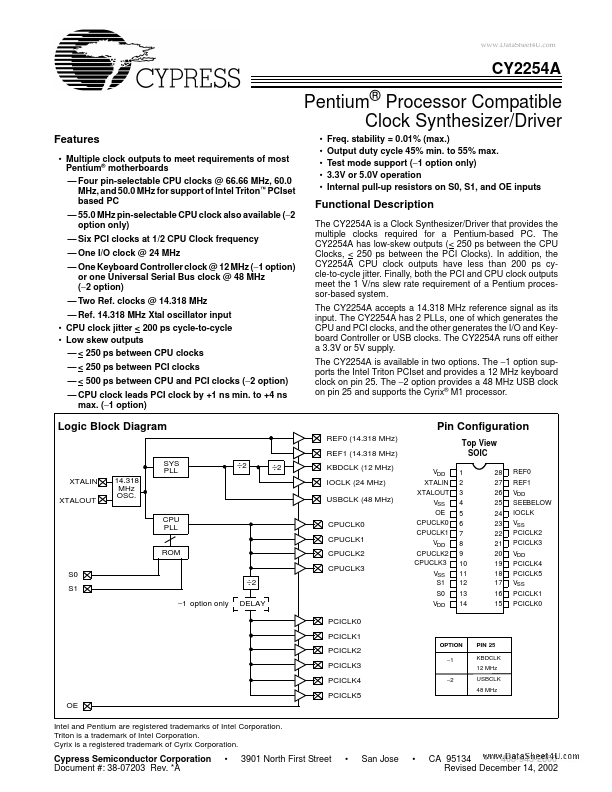
The CY2254A is a Clock Synthesizer/Driver that provides the multiple clocks required for a Pentium-based PC. The CY2254A has low-skew outputs (< 250 ps between the CPU Clocks, < 250 ps between the PCI Clocks). In addition, the CY2254A CPU clock outputs have less than 200 ps cycle-to-cycle jitter. Finally, both the PCI and CPU clock outputs meet the 1 V/ns slew rate requirement of a Pentium processor-based system. The CY2254A accepts a 14.318 MHz reference signal as its input. The CY2254A has 2 PLLs, one of which generates the CPU and PCI clocks, and the other generates the I/O and Keyboard Controller or USB clocks. The CY2254A runs off either a 3.3V or 5V supply. The CY2254A is available in two options. The
- 1 option supports the Intel Triton PCIset and provides a 12 MHz keyboard clock on pin 25. The
- 2 option provides a 48 MHz USB clock on pin 25 and supports the Cyrix® M1 processor.
Logic Block Diagram
REF0 (14.318 MHz)...