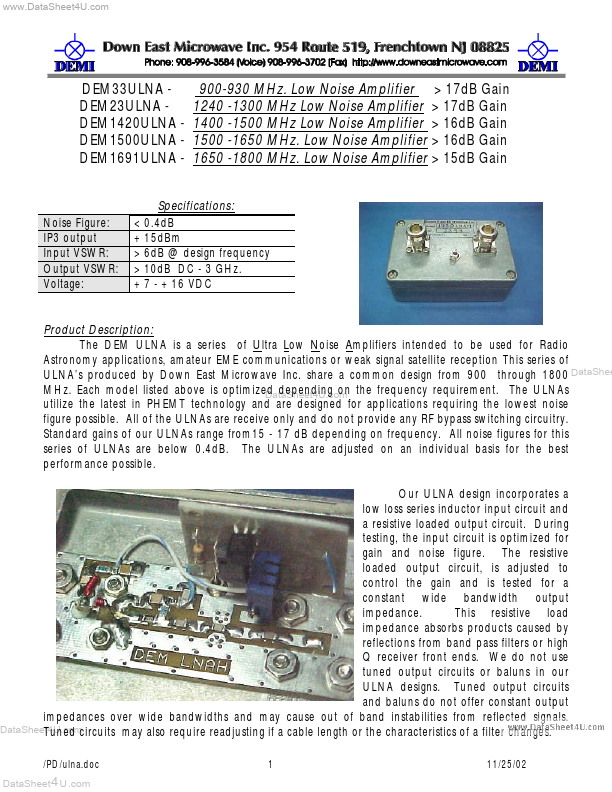
DEM33ULNA
DEM33ULNA is (DEMxxxULNA) Ultra Low Noise Amplifier manufactured by DEMI.
- Part of the DEMxxxULNA comparator family.
- Part of the DEMxxxULNA comparator family.
..
DEM33ULNA DEM23ULNA DEM1420ULNA DEM1500ULNA DEM1691ULNA
- 900-930 MHz. Low Noise Amplifier >17d B Gain 1240 -1300 MHz Low Noise Amplifier >17d B Gain 1400 -1500 MHz Low Noise Amplifier >16d B Gain 1500 -1650 MHz. Low Noise Amplifier >16d B Gain 1650 -1800 MHz. Low Noise Amplifier >15d B Gain
Noise Figure: IP3 output Input VSWR: Output VSWR: Voltage:
Specifications: <0.4d B +15d Bm >6d B @ design frequency >10d B DC
- 3 GHz. +7
- +16 VDC
Product Description: The DEM ULNA is a series of Ultra Low Noise Amplifiers intended to be used for Radio Astronomy applications, amateur EME munications or weak signal satellite reception This series of ULNA’s produced by Down East Microwave Inc. share a mon design from 900 through 1800 Data Shee MHz. Each model listed above is optimized depending on the frequency requirement. The ULNAs . utilize the latest in PHEMT technology and are designed for applications requiring the lowest noise figure possible. All of the ULNAs are receive only and do not provide any RF bypass switching circuitry. Standard gains of our ULNAs range from15
- 17 d B depending on frequency. All noise figures for this series of ULNAs are below 0.4d B. The ULNAs are adjusted on an individual basis for the best performance possible. Our ULNA design incorporates a low loss series inductor input circuit and a resistive loaded output circuit. During testing, the input circuit is optimized for gain and noise figure. The resistive loaded output circuit, is adjusted to control the gain and is tested for a constant wide bandwidth output impedance. This resistive load impedance absorbs products caused by reflections from band pass filters or high Q receiver front ends. We do not use tuned output circuits or baluns in our ULNA designs. Tuned output circuits and baluns do not offer constant output impedances over wide bandwidths and may cause out of band instabilities from reflected signals. . Tuned circuits may also require...