DS276
DS276 is Low Power Transceiver manufactured by Dallas Semiconducotr.
FEATURES
Low-power serial transmitter/receiver for battery-backed systems Transmitter steals power from receive signal line to save power Single 3V or 5V operation Full duplex operation up to 20k bps Ultra-low static current patible with RS-232-E signals
PIN ASSIGNMENT
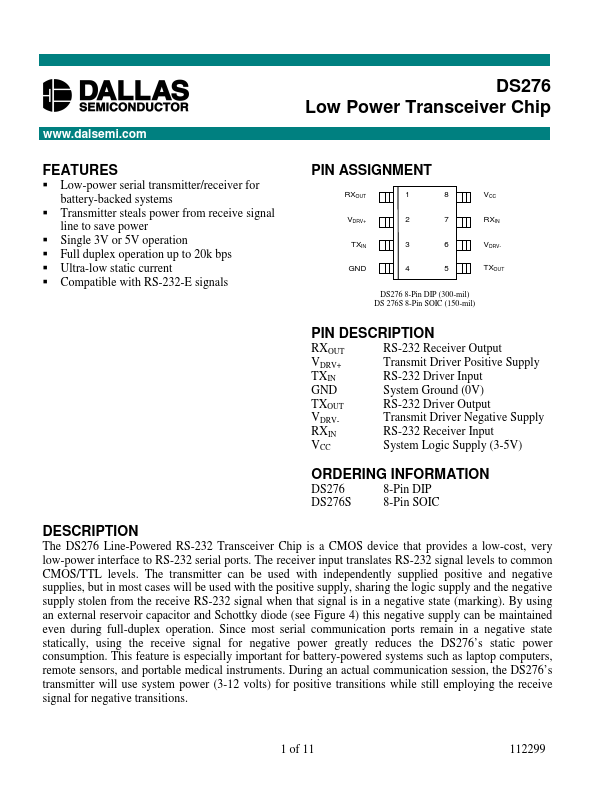
RXOUT VDRV+ TXIN GND 1 2 3 4 8 7 6 5 VCC RXIN VDRVTXOUT
DS276 8-Pin DIP (300-mil) DS 276S 8-Pin SOIC (150-mil)
PIN DESCRIPTION
RXOUT VDRV+ TXIN GND TXOUT VDRVRXIN VCC RS-232 Receiver Output Transmit Driver Positive Supply RS-232 Driver Input System Ground (0V) RS-232 Driver Output Transmit Driver Negative Supply RS-232 Receiver Input System Logic Supply (3-5V)
ORDERING INFORMATION
DS276 DS276S 8-Pin DIP 8-Pin SOIC
DESCRIPTION
The DS276 Line-Powered RS-232 Transceiver Chip is a CMOS device that provides a low-cost, very low-power interface to RS-232 serial ports. The receiver input translates RS-232 signal levels to mon CMOS/TTL levels. The transmitter can be used with independently supplied positive and negative supplies, but in most cases will be used with the positive supply, sharing the logic supply and the negative supply stolen from the receive RS-232 signal when that signal is in a negative state (marking). By using an external reservoir capacitor and Schottky diode (see Figure 4) this negative supply can be maintained even during full-duplex operation. Since most serial munication ports remain in a negative state statically, using the receive signal for negative power greatly reduces the DS276’s static power consumption. This feature is especially important for battery-powered systems such as laptop puters, remote sensors, and portable medical instruments. During an actual munication session, the DS276’s transmitter will use system power (3-12 volts) for positive transitions while still employing the receive signal for negative transitions.
1 of 11
OPERATION
Designed for the unique requirements of battery-backed systems, the DS276 provides a low-power full-or half-duplex...