DS1482
DS1482 is 1-Wire Level Shifter and Line Driver manufactured by Dallas Semiconductor.
FEATURES
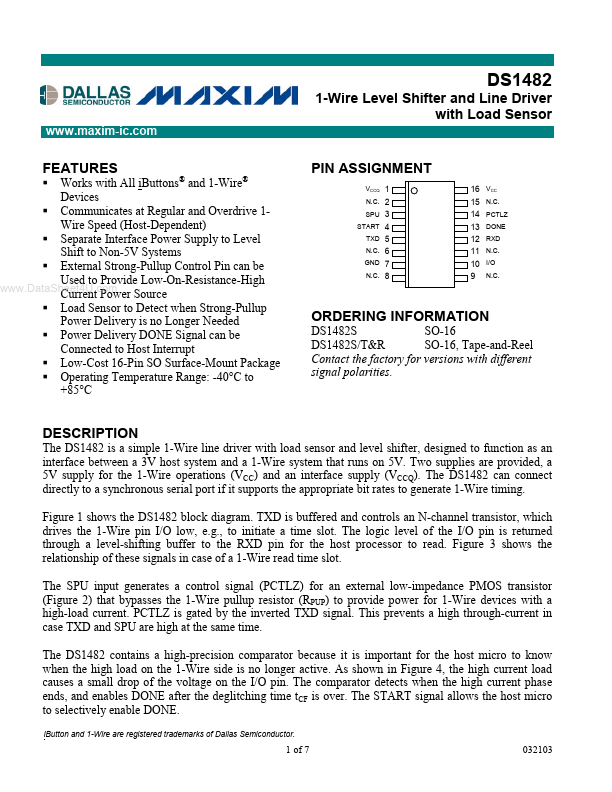
PIN ASSIGNMENT
VCCQ N.C. SPU START TXD N.C. GND N.C.
1 2 3 4 5 6 7 8
16 15 14 13 12 11 10 9
VCC N.C. PCTLZ DONE RXD N.C. I/O N.C.
ORDERING INFORMATION
DS1482S SO-16 DS1482S/T&R SO-16, Tape-and-Reel Contact the factory for versions with different signal polarities.
DESCRIPTION
The DS1482 is a simple 1-Wire line driver with load sensor and level shifter, designed to function as an interface between a 3V host system and a 1-Wire system that runs on 5V. Two supplies are provided, a 5V supply for the 1-Wire operations (VCC) and an interface supply (VCCQ). The DS1482 can connect directly to a synchronous serial port if it supports the appropriate bit rates to generate 1-Wire timing. Figure 1 shows the DS1482 block diagram. TXD is buffered and controls an N-channel transistor, which drives the 1-Wire pin I/O low, e.g., to initiate a time slot. The logic level of the I/O pin is returned through a level-shifting buffer to the RXD pin for the host processor to read. Figure 3 shows the relationship of these signals in case of a 1-Wire read time slot. The SPU input generates a control signal (PCTLZ) for an external low-impedance PMOS transistor (Figure 2) that bypasses the 1-Wire pullup resistor (RPUP) to provide power for 1-Wire devices with a high-load current. PCTLZ is gated by the inverted TXD signal. This prevents a high through-current in case TXD and SPU are high at the same time. The DS1482 contains a high-precision parator because it is important for the host micro to know when the high load on the 1-Wire side is no longer active. As shown in Figure 4, the high current load causes a small drop of the voltage on the I/O pin. The parator detects when the high current phase ends, and enables DONE after the deglitching time t CF is over. The START signal allows the host micro to selectively enable DONE. i Button and 1-Wire are registered trademarks of Dallas Semiconductor.
1 of 7
PIN 1 3 4 5 7 10 12
..
NAME VCCQ SPU START TXD GND I/O RXD...