AP1703
AP1703 is 3-PIN MICROPROCESSOR RESET manufactured by Diodes Incorporated.
- Part of the AP1701 comparator family.
- Part of the AP1701 comparator family.
AP1701/2/3/4
3-PIN MICROPROCESSOR RESET CIRCUITS
Features
- -
- -
- -
- -
- -
- - Precision Monitoring of +2.5V, +3V, +3.3V, and +5V Power-Supply Voltages Fully Specified Over Temperature Available in three Output Configurations Push-Pull RESET Low Output (AP1701/3) Push-Pull RESET High Output (AP1702/4) 200ms Min. Power-On Reset Pulse Width 20µA Supply Current (Typ.) Guaranteed Reset Valid to VCC = +1V Power Supply Transient Immunity No External ponents Green Package: SC59-3L Lead Free Finish / Ro HS pliant (Note1)
General Description
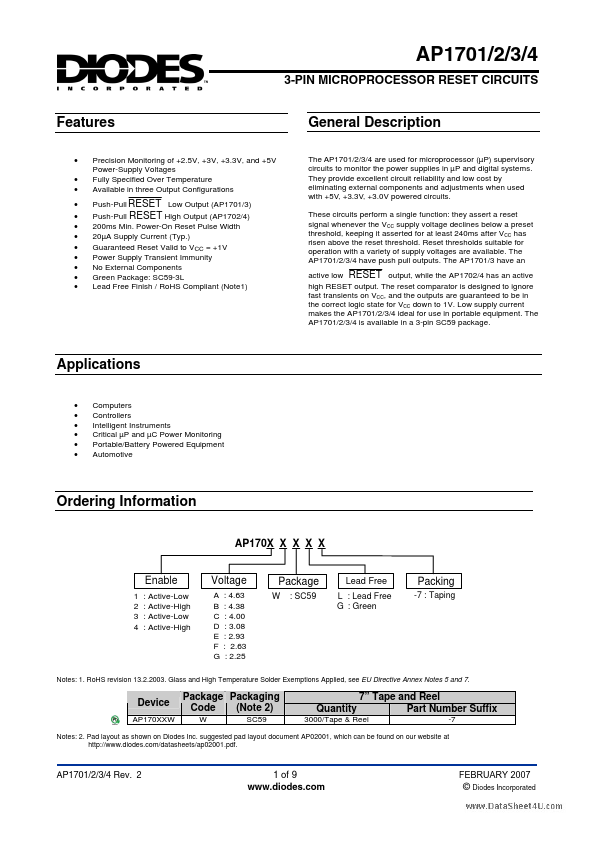
The AP1701/2/3/4 are used for microprocessor (µP) supervisory circuits to monitor the power supplies in µP and digital systems. They provide excellent circuit reliability and low cost by eliminating external ponents and adjustments when used with +5V, +3.3V, +3.0V powered circuits. These circuits perform a single function: they assert a reset signal whenever the VCC supply voltage declines below a preset threshold, keeping it asserted for at least 240ms after VCC has risen above the reset threshold. Reset thresholds suitable for operation with a variety of supply voltages are available. The AP1701/2/3/4 have push pull outputs. The AP1701/3 have an active low RESET output, while the AP1702/4 has an active high RESET output. The reset parator is designed to ignore fast transients on VCC, and the outputs are guaranteed to be in the correct logic state for VCC down to 1V. Low supply current makes the AP1701/2/3/4 ideal for use in portable equipment. The AP1701/2/3/4 is available in a 3-pin SC59 package.
Applications
- -
- -
- - puters Controllers Intelligent Instruments Critical µP and µC Power Monitoring Portable/Battery Powered Equipment Automotive
Ordering Information
AP170X X X X X
Enable
1 2 3 4 : Active-Low : Active-High : Active-Low : Active-High
Voltage
A B C D E F G : 4.63 : 4.38 : 4.00 : 3.08 : 2.93 : 2.63 : 2.25
Package
W : SC59
Lead Free
L : Lead Free G : Green
Packing
-7 : Taping
Notes: 1. Ro HS...