DPLS350E
DPLS350E is LOW VCE(SAT) PNP SURFACE MOUNT TRANSISTOR manufactured by Diodes Incorporated.
Features
- -
- -
- Epitaxial Planar Die Construction Ideally Suited for Automated Assembly Processes Ideal for Medium Power Switching or Amplification Applications Lead Free By Design/Ro HS pliant (Note 1) "Green" Device (Note 2)
Mechanical Data
- -
- -
- -
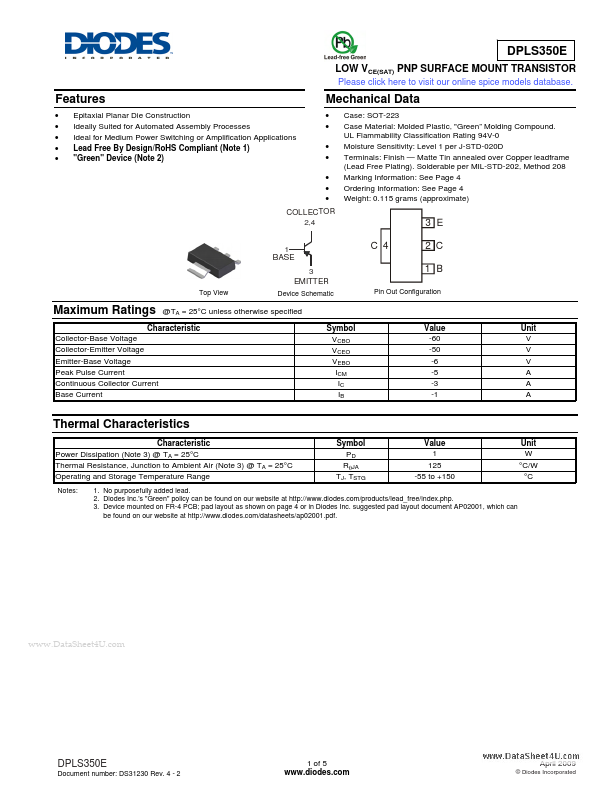
- COLLECTOR 2,4
Case: SOT-223 Case Material: Molded Plastic, "Green” Molding pound. UL Flammability Classification Rating 94V-0 Moisture Sensitivity: Level 1 per J-STD-020D Terminals: Finish
- Matte Tin annealed over Copper leadframe (Lead Free Plating). Solderable per MIL-STD-202, Method 208 Marking Information: See Page 4 Ordering Information: See Page 4 Weight: 0.115 grams (approximate)
3 E C 4 2 C 1 B
Pin Out Configuration
1 BASE 3 EMITTER
Top View Device Schematic
Maximum Ratings
@TA = 25°C unless otherwise specified Symbol VCBO VCEO VEBO ICM IC IB Value -60 -50 -6 -5 -3 -1 Unit V V V A A A
Characteristic Collector-Base Voltage Collector-Emitter Voltage Emitter-Base Voltage Peak Pulse Current Continuous Collector Current Base Current
Thermal Characteristics
Characteristic Power Dissipation (Note 3) @ TA = 25°C Thermal Resistance, Junction to Ambient Air (Note 3) @ TA = 25°C Operating and Storage Temperature Range
Notes:
Symbol PD RθJA TJ, TSTG
Value 1 125 -55 to +150
Unit W °C/W °C
1. No purposefully added lead. 2. Diodes Inc.'s "Green" policy can be found on our website at http://.diodes./products/lead_free/index.php. 3. Device mounted on FR-4 PCB; pad layout as shown on page 4 or in Diodes Inc. suggested pad layout document AP02001, which can be found on our website at http://.diodes./datasheets/ap02001.pdf.
..
Document number: DS31230 Rev. 4
- 2
1 of 5 .diodes.
April 2009
© Diodes Incorporated
DPLS350E Electrical Characteristics
Characteristic OFF CHARACTERISTICS (Note 4) Collector-Base Cutoff Current Emitter-Base Cutoff Current Collector-Base Breakdown Voltage Collector-Emitter Breakdown Voltage Emitter-Base Breakdown Voltage ON CHARACTERISTICS (Note 4) DC Current Gain @TA =...