Datasheet4U Logo Datasheet4U.com

TLC27L1B - CMOS LOW POWER OPERATIONAL AMPLIFIERS

Download the TLC27L1B datasheet PDF. This datasheet also covers the TLC27L1 variant, as both devices belong to the same cmos low power operational amplifiers family and are provided as variant models within a single manufacturer datasheet.

General Description

The TLC27L1 operational amplifier combines a wide range of input offset-voltage grades with low offset-voltage drift and high input impedance.

The TLC27L1 is a low-bias version of the TLC271 programmable amplifier.

Key Features

  • Wide range of supply voltages over specified temperature range: 0°C to +70°C . . . 3 V to 16 V.
  • 40°C to +85°C . . . 4 V to 16 V.
  • Single-Supply Operation.
  • Common-Mode Input Voltage Range Extends Below the Negative Rail.
  • Low Noise: 68nV/√Hz typical @ f = 1kHz.
  • Output Voltage Range Includes Negative Rail.
  • High Input Impedance.
  • Designed-In Latch-Up Immunity.
  • Totally Lead-Free & Fully RoHS Compliant (Notes 1 & 2).
  • Halogen and Antimony Free. “Green.

📥 Download Datasheet

Note: The manufacturer provides a single datasheet file (TLC27L1-Diodes.pdf) that lists specifications for multiple related part numbers.

Full PDF Text Transcription (Reference)

The following content is an automatically extracted verbatim text from the original manufacturer datasheet and is provided for reference purposes only.

View original datasheet text
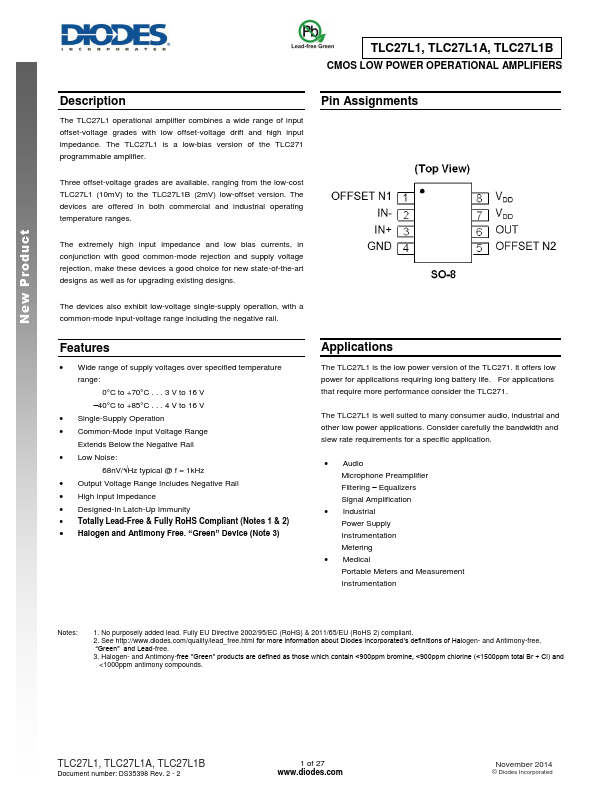
New Product TLC27L1, TLC27L1A, TLC27L1B CMOS LOW POWER OPERATIONAL AMPLIFIERS Description The TLC27L1 operational amplifier combines a wide range of input offset-voltage grades with low offset-voltage drift and high input impedance. The TLC27L1 is a low-bias version of the TLC271 programmable amplifier. Pin Assignments Three offset-voltage grades are available, ranging from the low-cost TLC27L1 (10mV) to the TLC27L1B (2mV) low-offset version. The devices are offered in both commercial and industrial operating temperature ranges. The extremely high input impedance and low bias currents, in conjunction with good common-mode rejection and supply voltage rejection, make these devices a good choice for new state-of-the-art designs as well as for upgrading existing designs.