
Datasheet4U Logo Datasheet4U.com

EM4305 - 512 bit Read/Write Multi-purpose Contactless Identification Device

This page provides the datasheet information for the EM4305, a member of the EM4205 512 bit Read/Write Multi-purpose Contactless Identification Device family.

Datasheet Summary

Description

EM4205/4305 is a CMOS integrated circuit intended for use in electronic Read/Write RF transponders.

It is suitable for low cost solutions like animal tagging applications.
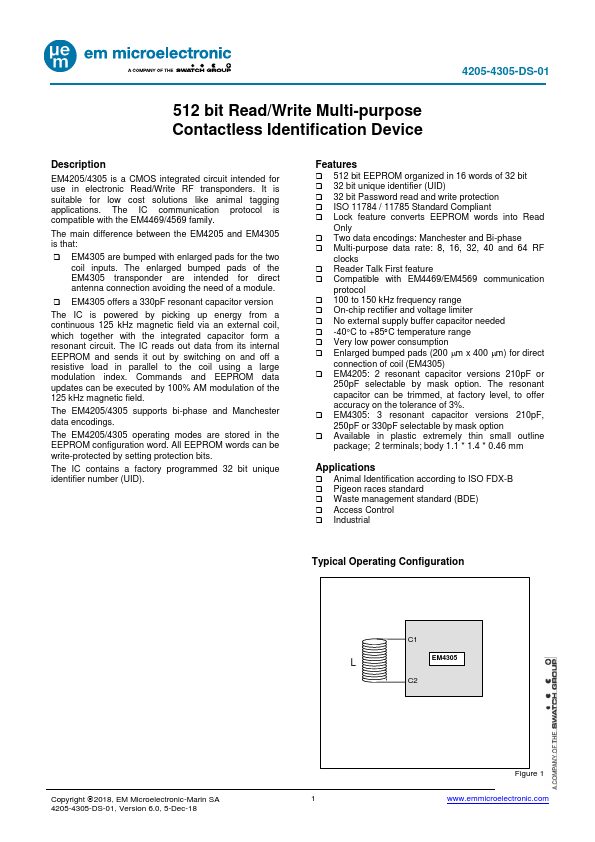
The IC communication protocol is compatible with the EM4469/4569 family.

Features

  • ‰ 512 bit EEPROM organized in 16 words of 32 bit ‰ 32 bit unique identifier (UID) ‰ 32 bit Password read and write protection ‰ ISO 11784 / 11785 Standard Compliant ‰ Lock feature converts EEPROM words into Read Only ‰ Two data encodings: Manchester and Bi-phase ‰ Multi-purpose data rate: 8, 16, 32 and 64 RF clocks ‰ Reader Talk First feature ‰ Compatible with EM4469/EM4569 communication protocol ‰ 100 to 150 kHz frequency range ‰ On-chip rectifier and voltage limiter ‰ No external supply buffer.

📥 Download Datasheet

Datasheet preview – EM4305

Datasheet Details

Part number EM4305
Manufacturer EM Microelectronic
File Size 327.70 KB
Description 512 bit Read/Write Multi-purpose Contactless Identification Device
Datasheet download datasheet EM4305 Datasheet
Additional preview pages of the EM4305 datasheet.
Other Datasheets by EM Microelectronic

Full PDF Text Transcription

Click to expand full text
EM MICROELECTRONIC - MARIN SA EM4205 EM4305 512 bit Read/Write Multi-purpose Contactless Identification Device Description EM4205/4305 is a CMOS integrated circuit intended for use in electronic Read/Write RF transponders. It is suitable for low cost solutions like animal tagging applications. The IC communication protocol is compatible with the EM4469/4569 family. The main difference between the EM4205 and EM4305 is that: ‰ EM4305 are bumped with enlarged pads for the two coil inputs. The enlarged bumped pads of the EM4305 transponder are intended for direct antenna connection avoiding the need of a module.

Published: |