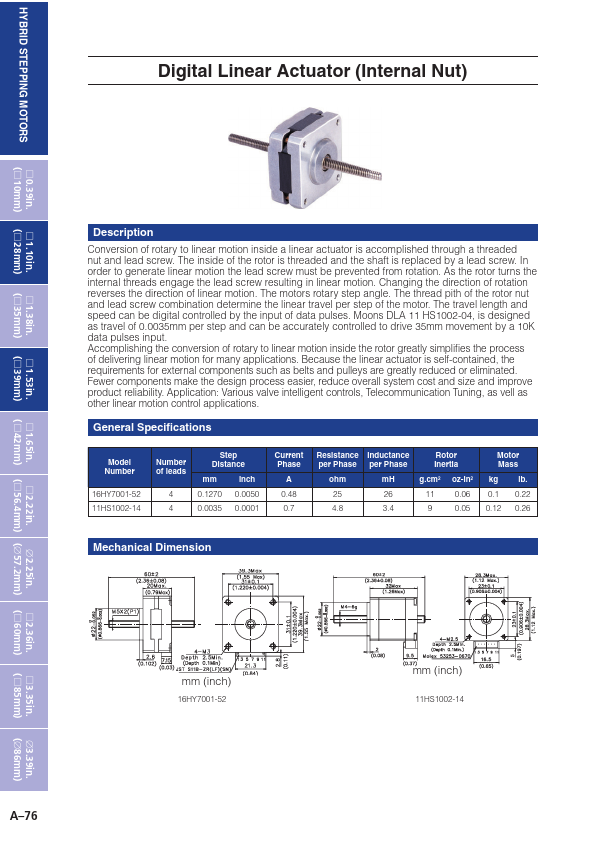
11HS1002-14
Description
Conversion of rotary to linear motion inside a linear actuator is acplished through a threaded nut and lead screw. The inside of the rotor is threaded and the shaft is replaced by a lead screw. In order to generate linear motion the lead screw must be prevented from rotation. As the rotor turns the internal threads engage the lead screw resulting in linear motion. Changing the direction of rotation reverses the direction of linear motion. The motors rotary step angle. The thread pith of the rotor nut and lead screw bination determine the linear travel per step of the motor. The travel length and speed can be digital controlled by the input of data pulses. Moons DLA 11 HS1002-04, is designed as travel of 0.0035mm per step and can be accurately controlled to drive 35mm movement by a 10K data pulses input. Acplishing the conversion of rotary to linear motion inside the rotor greatly simplifies the process of delivering linear motion for many applications. Because the linear...