FT639
FT639 is Servo Controller Chip manufactured by Unknown Manufacturer.
Description
:
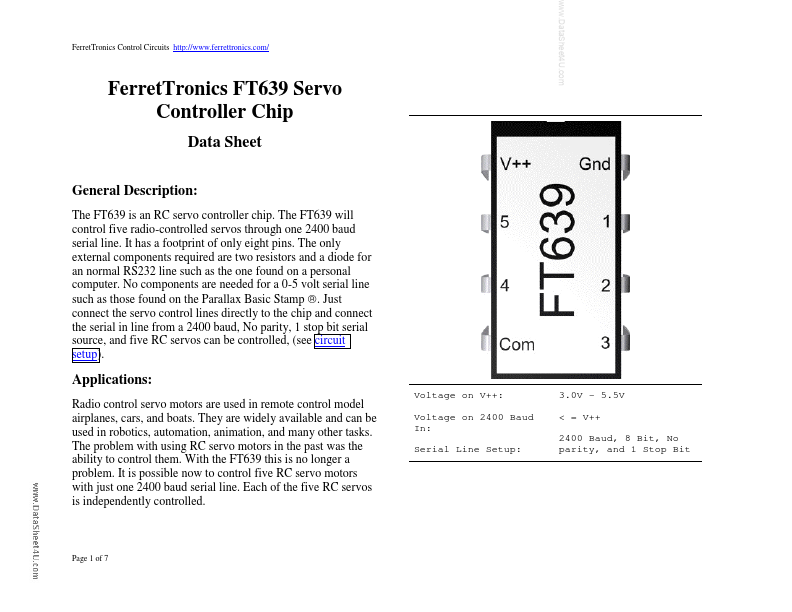
The FT639 is an RC servo controller chip. The FT639 will control five radio-controlled servos through one 2400 baud serial line. It has a footprint of only eight pins. The only external ponents required are two resistors and a diode for an normal RS232 line such as the one found on a personal puter. No ponents are needed for a 0-5 volt serial line such as those found on the Parallax Basic Stamp . Just connect the servo control lines directly to the chip and connect the serial in line from a 2400 baud, No parity, 1 stop bit serial source, and five RC servos can be controlled, (see circuit setup).
Applications:
Radio control servo motors are used in remote control model airplanes, cars, and boats. They are widely available and can be used in robotics, automation, animation, and many other tasks. The problem with using RC servo motors in the past was the ability to control them. With the FT639 this is no longer a problem. It is possible now to control five RC servo motors with just one 2400 baud serial line. Each of the five RC servos is independently controlled.
Voltage on V++: Voltage on 2400 Baud In: Serial Line Setup: 3.0V
- 5.5V < = V++ 2400 Baud, 8 Bit, No parity, and 1 Stop Bit
Page 1 of 7
..
Ferret Tronics Control Circuits http://.ferrettronics./
Operations:
FT639 has two operating modes: Setup mode and Active mode. The chip starts in Setup mode. Setup mode is used to set the pulse length, header length and starting values for the 5 servos. Active mode sends the control pulses to the servos and controls the servos through the 2400 baud serial line. mands are sent to the FT639 through a 2400 baud, 8 bit, no parity, 1 stop bit serial line. The mands are all one byte. Each mand is one character sent over the 2400 baud serial line. Each RC servo has 256 positions. To send the position of a servo to the FT639 requires two mands. The first mand contains the servo number and the lower nibble (lower 4 bits) of the positional number. The second mand...