RN552 - THIN FILM AMORPHOUS SILICON POSITION SENSITIVE DETECTORS
Key Features
such as excellent adhesion to glass substrates, precise film thickness, and hydrogen content control, which are of some interest in device design and fabrication. 1. Introduction
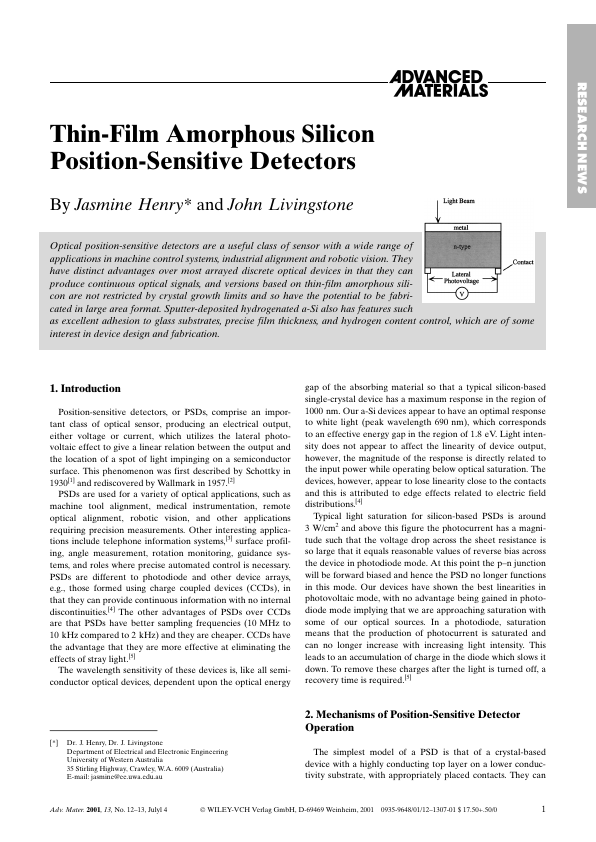
Position-sensitive detectors, or PSDs, comprise an important class of optical sensor, producing an electrical output, either voltage or current, which utilizes the lateral photovoltaic effect to give a linear relation between the output and the location of a spot of light impinging on a semiconductor surface. This phen.
Note: Below is a high-fidelity text extraction (approx. 800 characters) for
RN552. For precise diagrams, and layout, please refer to the original PDF.
RESEARCH NEWS Thin-Film Amorphous Silicon Position-Sensitive Detectors By Jasmine Henry* and John Livingstone Optical position-sensitive detectors are a useful class of s...
View more extracted text
vingstone Optical position-sensitive detectors are a useful class of sensor with a wide range of applications in machine control systems, industrial alignment and robotic vision. They have distinct advantages over most arrayed discrete optical devices in that they can produce continuous optical signals, and versions based on thin-film amorphous silicon are not restricted by crystal growth limits and so have the potential to be fabricated in large area format. Sputter-deposited hydrogenated a-Si also has features such as excellent adhesion to glass substrates, precise film thickness, and hydrogen content control, which are