Overview: TSL2561 Luminosity Sensor Hookup Guide a learn.sparkfun.
tutorial Available online at: http://sfe.io/t167 Contents
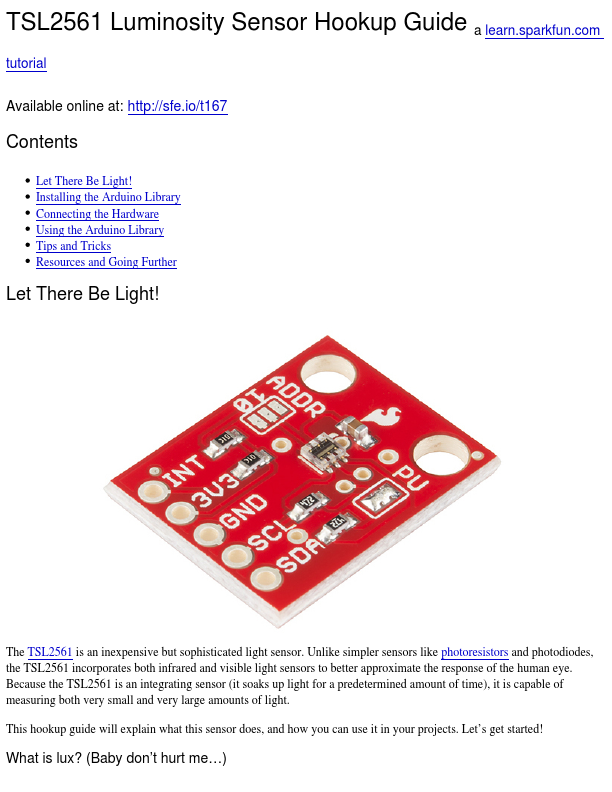
Let There Be Light! Installing the Arduino Library Connecting the Hardware Using the Arduino Library Tips and Tricks Resources and Going Further Let There Be Light! The TSL2561 is an inexpensive but sophisticated light sensor. Unlike simpler sensors like photoresistors and photodiodes, the TSL2561 incorporates both infrared and visible light sensors to better approximate the response of the human eye. Because the TSL2561 is an integrating sensor (it soaks up light for a predetermined amount of time), it is capable of measuring both very small and very large amounts of light. This hookup guide will explain what this sensor does, and how you can use it in your projects. Let’s get started! What is lux? (Baby don’t hurt me…) With a bit of math, the TSL2561 can output illumination in lux. Technically, one lux is equal to one lumen per square meter. Practially, lux is a measure of how bright any given illumination will appear to the human eye. The human eye has a huge dynamic range, far more than most electronic sensors. Real-world conditions can range from 0.0001 lux in starlight, to over 100,000 lux in direct sunlight.