Datasheet4U Logo Datasheet4U.com

EMA1901 - 1.25W Mono Audio Power Amplifier

Datasheet Summary

Description

The EMA1901 is an audio power amplifier primarily designed for portable communication applications such as mobile phones and portable multimedia players (PMP).

To an 8Ω BTL load, it can deliver 1.25 watt of continuous average power with less than 1% distortion (THD+N) from a 5VDC supply.
Features

  • a low-power consumption shutdown mode, and an internal thermal shutdown protection mechanism. Advanced pop & click circuitry is built in to eliminate noises that would otherwise occur during turn-on and turn-off transitions. The EMA1901 is unity-gain stable and can be configured by external gain-setting resistors. EMP products are RoHS and Halogen free compliant.
  • PSRR at 217Hz, VDD = 5V (Fig. 1) Power Output at 5.0V & 1% THD Power Output at 2.6V & 1% THD S.

📥 Download Datasheet

Datasheet preview – EMA1901

Datasheet Details

Part number EMA1901
Manufacturer Elite Semiconductor
File Size 214.23 KB
Description 1.25W Mono Audio Power Amplifier
Datasheet download datasheet EMA1901 Datasheet
Additional preview pages of the EMA1901 datasheet.
Other Datasheets by Elite Semiconductor

Full PDF Text Transcription

Click to expand full text
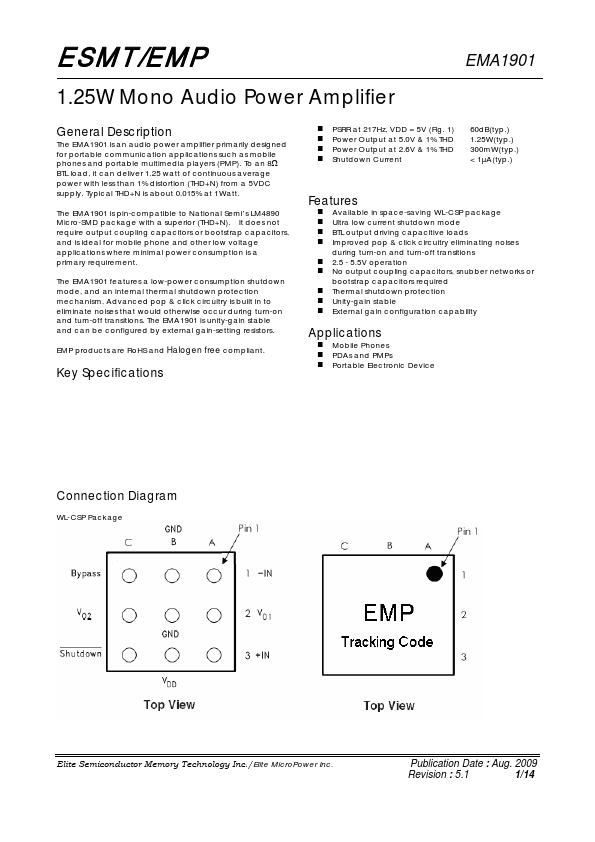
ESMT/EMP 1.25W Mono Audio Power Amplifier General Description The EMA1901 is an audio power amplifier primarily designed for portable communication applications such as mobile phones and portable multimedia players (PMP). To an 8Ω BTL load, it can deliver 1.25 watt of continuous average power with less than 1% distortion (THD+N) from a 5VDC supply. Typical THD+N is about 0.015% at 1Watt. The EMA1901 is pin-compatible to National Semi’s LM4890 Micro-SMD package with a superior (THD+N). It does not require output coupling capacitors or bootstrap capacitors, and is ideal for mobile phone and other low voltage applications where minimal power consumption is a primary requirement. The EMA1901 features a low-power consumption shutdown mode, and an internal thermal shutdown protection mechanism.
Published: |