Datasheet4U Logo Datasheet4U.com

ETK4992 - 1.25 Watt Fully Differential Audio Power Amplifier

Datasheet Summary

Description

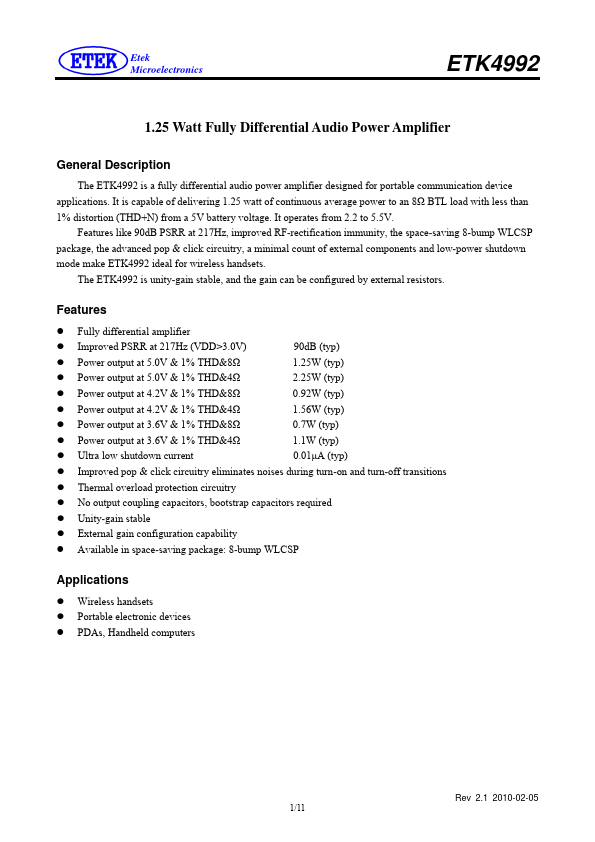
The ETK4992 is a fully differential audio power amplifier designed for portable communication device applications.

It is capable of delivering 1.25 watt of continuous average power to an 8Ω BTL load with less than 1% distortion (THD+N) from a 5V battery voltage.

It operates from 2.2 to 5.5V.

Features

  • like 90dB PSRR at 217Hz, improved RF-rectification immunity, the space-saving 8-bump WLCSP package, the advanced pop & click circuitry, a minimal count of external components and low-power shutdown mode make ETK4992 ideal for wireless handsets. The ETK4992 is unity-gain stable, and the gain can be configured by external resistors. Features z Fully differential amplifier z Improved PSRR at 217Hz (VDD>3.0V) 90dB (typ) z Power output at 5.0V & 1% THD&8Ω 1.25W (typ) z Power output at 5.0V & 1.

📥 Download Datasheet

Datasheet preview – ETK4992

Datasheet Details

Part number ETK4992
Manufacturer Etek Microelectronics
File Size 288.84 KB
Description 1.25 Watt Fully Differential Audio Power Amplifier
Datasheet download datasheet ETK4992 Datasheet
Additional preview pages of the ETK4992 datasheet.
Other Datasheets by Etek Microelectronics

Full PDF Text Transcription

Click to expand full text
Etek Microelectronics ETK4992 1.25 Watt Fully Differential Audio Power Amplifier General Description The ETK4992 is a fully differential audio power amplifier designed for portable communication device applications. It is capable of delivering 1.25 watt of continuous average power to an 8Ω BTL load with less than 1% distortion (THD+N) from a 5V battery voltage. It operates from 2.2 to 5.5V. Features like 90dB PSRR at 217Hz, improved RF-rectification immunity, the space-saving 8-bump WLCSP package, the advanced pop & click circuitry, a minimal count of external components and low-power shutdown mode make ETK4992 ideal for wireless handsets. The ETK4992 is unity-gain stable, and the gain can be configured by external resistors.
Published: |