EUP3468B
EUP3468B is Dual-Channel CC/CV Mode Synchronous Step-Down Controller manufactured by Eutech Microelectronics.
Dual-Channel CC/CV Mode Synchronous Step-Down Controller
DESCRIPTION
The EUP3468B is a dual-channel synchronous step-down controller capable of driving 5A continuous load with excellent line and load regulation. The EUP3468B operates in either CC (Constant Current) mode or CV (Constant Voltage) mode with an input voltage range from 8V to 36V. The EUP3468B can be configured as single output or dual outputs with independent programmable CC threshold for current limitation. The EUP3468B provides programmable cable pensation by adjusting external resistor divider. External shutdown function can be controlled by pulling P pin to a level below 0.14V.
Fault protection includes secondary cycle-by-cycle current limit, short circuit protection and thermal shutdown. Internal soft-start minimizes the inrush supply current and the output overshoot at initial startup.
The EUP3468B is available in MSOP-10 package.
Features
8V to 36V Wide Input Operating Range 40V Input Voltage Surge 80k Hz~800k Hz Switching Frequency Selection Dual Channel CC/CV Mode Control Up to 5A Output Current +/- 1% Voltage Reference Accuracy +/- 4% Constant Current Accuracy Programmable Cable pensation Internal Soft Start Single Pin to External pensation and Shutdown Control Hiccup Short Circuit Protection Secondary Cycle-by-Cycle Current Limit Thermal Shutdown Available in MSOP-10 Package Ro HS pliant and 100% Lead(Pb)-Free Halogen-Free
APPLICATIONS
Car Charger Portable charger applications DC/DC converters with current limited
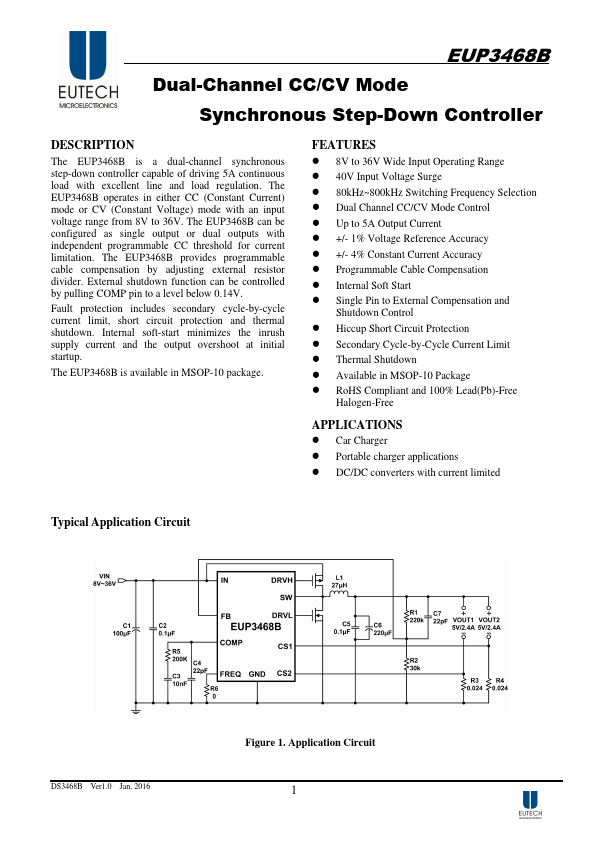
Typical Application Circuit
DS3468B Ver1.0 Jan. 2016
Figure 1. Application Circuit
Ordering Information
Order Number EUP3468BMIR1
Package Type MSOP-10
Marking xxxxx 3468B
Quantity per Reel Operating Temperature Range
-40°C to +85°C
- -
- -
Lead Free Code 1: Lead Free, Halogen Free
Packing R: Tape & Reel
Operating temperature range I: Industry Standard Package Type M: MSOP
DS3468B Ver1.0 Jan....