Datasheet4U Logo Datasheet4U.com

ST16C1451 - (ST16C1450 / ST16C1451) 2.97V TO 5.5V UART

Download the ST16C1451 datasheet PDF. This datasheet also covers the ST16C1450 variant, as both devices belong to the same (st16c1450 / st16c1451) 2.97v to 5.5v uart family and are provided as variant models within a single manufacturer datasheet.

General Description

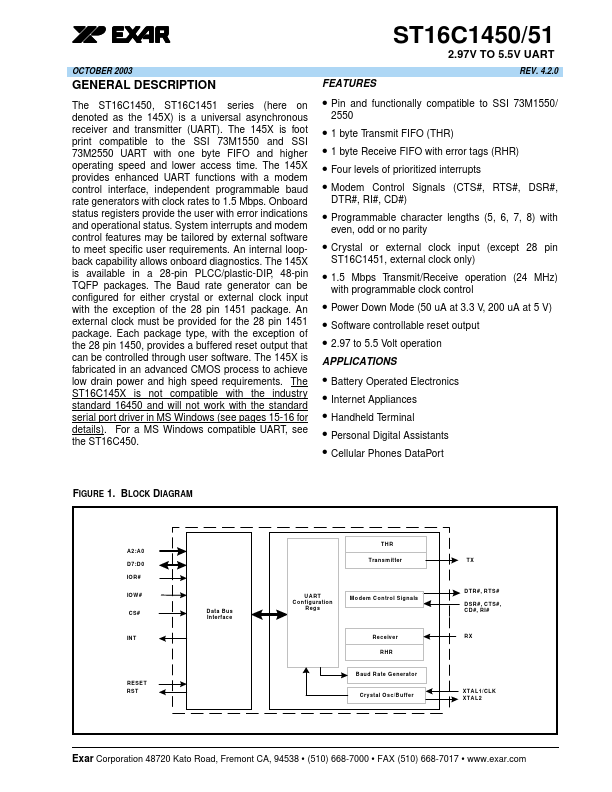
The ST16C1450, ST16C1451 series (here on denoted as the 145X) is a universal asynchronous receiver and transmitter (UART).

The 145X is foot print compatible to the SSI 73M1550 and SSI 73M2550 UART with one byte FIFO and higher operating speed and lower access time.

Key Features

  • may be tailored by external software to meet specific user requirements. An internal loopback capability allows onboard diagnostics. The 145X is available in a 28-pin PLCC/plastic-DIP , 48-pin TQFP packages. The Baud rate generator can be configured for either crystal or external clock input with the exception of the 28 pin 1451 package. An external clock must be provided for the 28 pin 1451 package. Each package type, with the exception of the 28 pin 1450, provides a buffered reset output that.

📥 Download Datasheet

Note: The manufacturer provides a single datasheet file (ST16C1450_ExarCorporation.pdf) that lists specifications for multiple related part numbers.

Full PDF Text Transcription (Reference)

The following content is an automatically extracted verbatim text from the original manufacturer datasheet and is provided for reference purposes only.

View original datasheet text
รกรง OCTOBER 2003 ST16C1450/51 2.97V TO 5.5V UART REV. 4.2.0 GENERAL DESCRIPTION The ST16C1450, ST16C1451 series (here on denoted as the 145X) is a universal asynchronous receiver and transmitter (UART). The 145X is foot print compatible to the SSI 73M1550 and SSI 73M2550 UART with one byte FIFO and higher operating speed and lower access time. The 145X provides enhanced UART functions with a modem control interface, independent programmable baud rate generators with clock rates to 1.5 Mbps. Onboard status registers provide the user with error indications and operational status. System interrupts and modem control features may be tailored by external software to meet specific user requirements. An internal loopback capability allows onboard diagnostics.