• Part: ST16C2550
  • Description: 2.97V TO 5.5V DUART
  • Manufacturer: Exar
  • Size: 396.16 KB
Download ST16C2550 Datasheet PDF
Exar
ST16C2550
ST16C2550 is 2.97V TO 5.5V DUART manufactured by Exar.
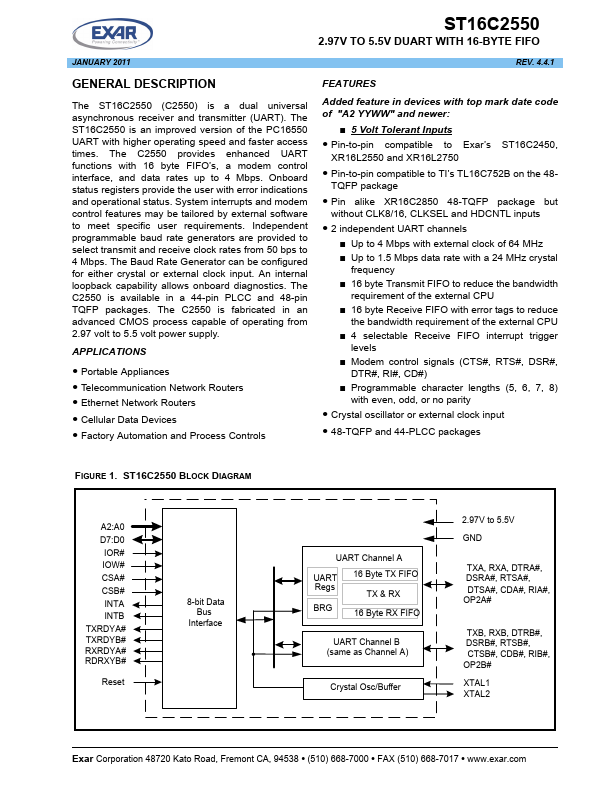
DESCRIPTION The ST16C2550 (C2550) is a dual universal asynchronous receiver and transmitter (UART). The ST16C2550 is an improved version of the PC16550 UART with higher operating speed and faster access times. The C2550 provides enhanced UART functions with 16 byte FIFO’s, a modem control interface, and data rates up to 4 Mbps. Onboard status registers provide the user with error indications and operational status. System interrupts and modem control features may be tailored by external software to meet specific user requirements. Independent programmable baud rate generators are provided to select transmit and receive clock rates from 50 bps to 4 Mbps. The Baud Rate Generator can be configured for either crystal or external clock input. An internal loopback capability allows onboard diagnostics. The C2550 is available in a 44-pin PLCC and 48-pin TQFP packages. The C2550 is fabricated in an advanced CMOS process capable of operating from 2.97 volt to 5.5 volt power supply. APPLICATIONS - Portable Appliances - Telemunication Network Routers - Ethernet Network Routers - Cellular Data Devices - Factory Automation and Process Controls FEATURES Added feature in devices with top mark date code of "A2 YYWW" and newer: - 5 Volt Tolerant Inputs - Pin-to-pin patible to Exar’s ST16C2450, XR16L2550 and XR16L2750 - Pin-to-pin patible to TI’s TL16C752B on the 48- TQFP package - Pin alike XR16C2850 48-TQFP package but without CLK8/16, CLKSEL and HDCNTL inputs - 2 independent UART channels - Up to 4 Mbps with external clock of 64 MHz - Up to 1.5 Mbps data rate with a 24 MHz crystal frequency - 16 byte Transmit FIFO to reduce the bandwidth requirement of the external CPU - 16 byte Receive FIFO with error tags to reduce the bandwidth requirement of the external CPU - 4 selectable Receive FIFO interrupt trigger levels - Modem control signals (CTS#, RTS#, DSR#, DTR#, RI#, CD#) - Programmable character lengths (5, 6, 7, 8) with even, odd, or no parity - Crystal oscillator or external...