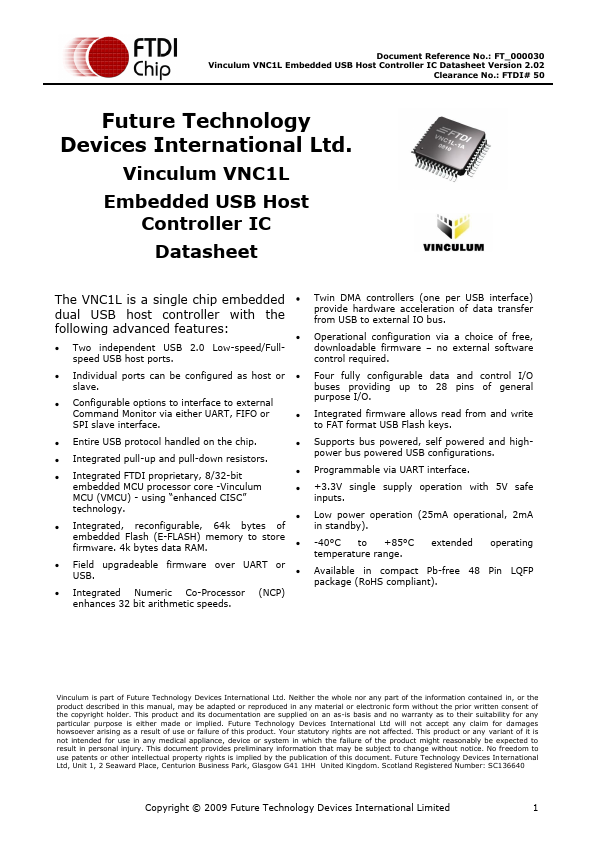
VNC1L-1A
VNC1L-1A is Vinculum VNC1L Embedded USB Host Controller manufactured by FTDI.
features
:
Two independent USB 2.0 Low-speed/Fullspeed USB host ports. Individual ports can be configured as host or slave. Configurable options to interface to external mand Monitor via either UART, FIFO or SPI slave interface. Entire USB protocol handled on the chip. Integrated pull-up and pull-down resistors. Integrated FTDI proprietary, 8/32-bit embedded MCU processor core -Vinculum MCU (VMCU)
- using “enhanced CISC” technology. Integrated, reconfigurable, 64k bytes of embedded Flash (E-FLASH) memory to store firmware. 4k bytes data RAM. Field upgradeable firmware over UART or USB. Integrated Numeric Co-Processor enhances 32 bit arithmetic speeds. (NCP) Twin DMA controllers (one per USB interface) provide hardware acceleration of data transfer from USB to external IO bus. Operational configuration via a choice of free, downloadable firmware
- no external software control required. Four fully configurable data and control I/O buses providing up to 28 pins of general purpose I/O. Integrated firmware allows read from and write to FAT format USB Flash keys. Supports bus powered, self powered and highpower bus powered USB configurations. Programmable via UART interface. +3.3V single supply operation with 5V safe inputs. Low power operation (25m A operational, 2m A in standby). -40°C to +85°C temperature range. extended operating
Available in pact Pb-free 48 Pin LQFP package (Ro HS pliant).
Vinculum is part of Future Technology Devices International Ltd. Neither the whole nor any part of the information contained in, or the product described in this manual, may be adapted or reproduced in any material or electronic form without the prior written consent of the copyright holder. This product and its documentation are supplied on an as-is basis and no warranty as to their suitability for any particular purpose is either made or implied. Future Technology Devices International Ltd will not accept any claim for damages howsoever arising as a result of use or failure of...