Datasheet4U Logo Datasheet4U.com

74LS374 - 3-STATE Octal D-Type Transparent Latches and Edge-Triggered Flip-Flops

Download the 74LS374 datasheet PDF. This datasheet also covers the 74LS373 variant, as both devices belong to the same 3-state octal d-type transparent latches and edge-triggered flip-flops family and are provided as variant models within a single manufacturer datasheet.

General Description

These 8-bit registers feature totem-pole 3-STATE outputs designed specifically for driving highly-capacitive or relatively low-impedance loads.

Key Features

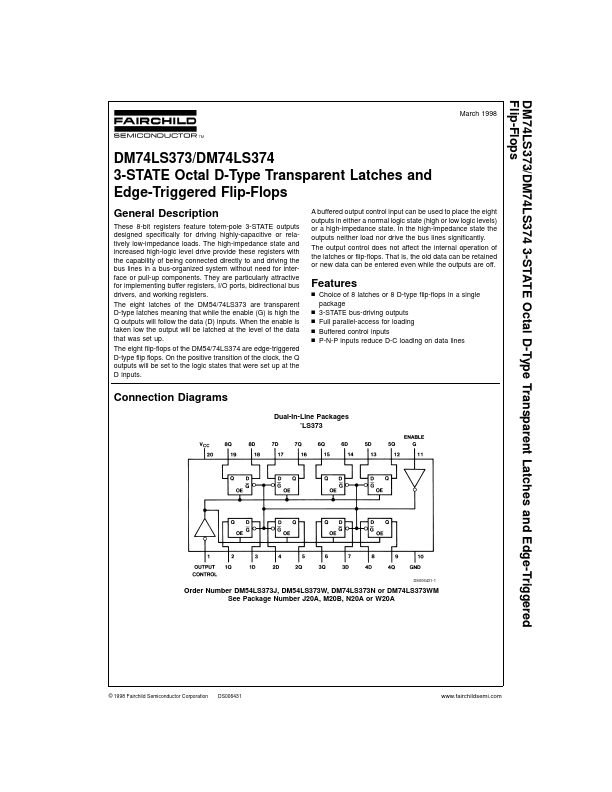
  • n Choice of 8 latches or 8 D-type flip-flops in a single package n 3-STATE bus-driving outputs n Full parallel-access for loading n Buffered control inputs n P-N-P inputs reduce D-C loading on data lines Connection Diagrams Dual-In-Line Packages ’LS373 DS006431-1 Order Number DM54LS373J, DM54LS373W, DM74LS373N or DM74LS373WM See Package Number J20A, M20B, N20A or W20A © 1998 Fairchild Semiconductor Corporation DS006431 www. fairchildsemi. com Connection Diagrams (Continued) ’LS374 DS006431.

📥 Download Datasheet

Note: The manufacturer provides a single datasheet file (74LS373-FairchildSemiconductor.pdf) that lists specifications for multiple related part numbers.

Full PDF Text Transcription (Reference)

The following content is an automatically extracted verbatim text from the original manufacturer datasheet and is provided for reference purposes only.

View original datasheet text
DM74LS373/DM74LS374 3-STATE Octal D-Type Transparent Latches and Edge-Triggered Flip-Flops March 1998 DM74LS373/DM74LS374 3-STATE Octal D-Type Transparent Latches and Edge-Triggered Flip-Flops General Description These 8-bit registers feature totem-pole 3-STATE outputs designed specifically for driving highly-capacitive or relatively low-impedance loads. The high-impedance state and increased high-logic level drive provide these registers with the capability of being connected directly to and driving the bus lines in a bus-organized system without need for interface or pull-up components. They are particularly attractive for implementing buffer registers, I/O ports, bidirectional bus drivers, and working registers.