

Datasheet4U Logo Datasheet4U.com

74VCX162245 - Low Voltage 16-Bit Bidirectional Transceiver

Datasheet Summary

Description

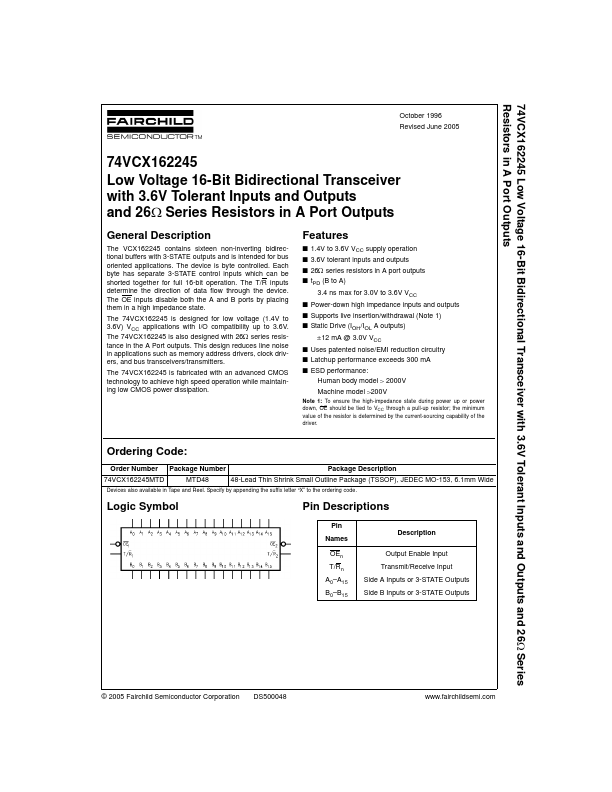
The VCX162245 contains sixteen non-inverting bidirectional buffers with 3-STATE outputs and is intended for bus oriented applications.

The device is byte controlled.

Each byte has separate 3-STATE control inputs which can be shorted together for full 16-bit operation.

Features

  • s 1.4V to 3.6V VCC supply operation s 3.6V tolerant inputs and outputs s 26: series resistors in A port outputs s tPD (B to A) 3.4 ns max for 3.0V to 3.6V VCC s Power-down high impedance inputs and outputs s Supports live insertion/withdrawal (Note 1) s Static Drive (IOH/IOL A outputs) r12 mA @ 3.0V VCC s Uses patented noise/EMI reduction circuitry s Latchup performance exceeds 300 mA s ESD performance: Human body model ! 2000V Machine model !200V Note 1: To ensure the high-impedance state du.

📥 Download Datasheet

Datasheet preview – 74VCX162245

Datasheet Details

Part number 74VCX162245
Manufacturer Fairchild Semiconductor
File Size 172.51 KB
Description Low Voltage 16-Bit Bidirectional Transceiver
Datasheet download datasheet 74VCX162245 Datasheet
Additional preview pages of the 74VCX162245 datasheet.
Other Datasheets by Fairchild Semiconductor

Full PDF Text Transcription

Click to expand full text
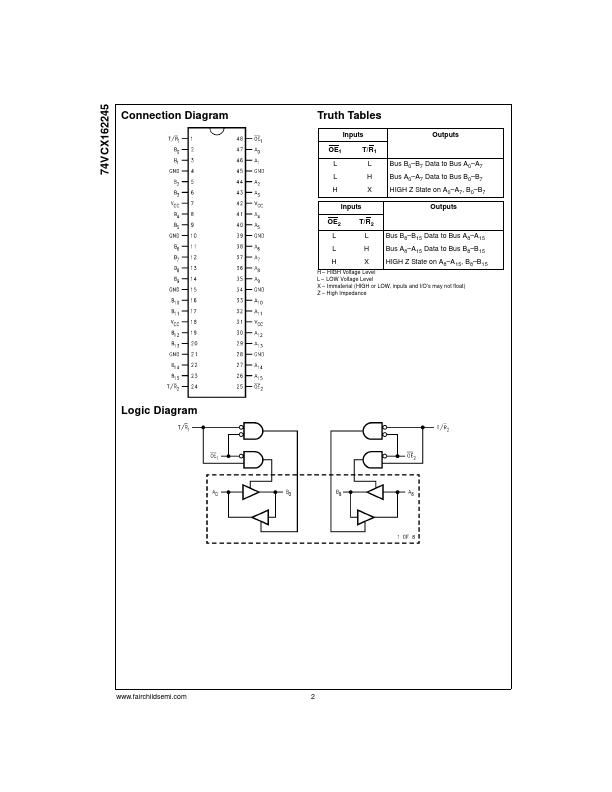
www.DataSheet4U.com 74VCX162245 Low Voltage 16-Bit Bidirectional Transceiver with 3.6V Tolerant Inputs and Outputs and 26: Series Resistors in A Port Outputs October 1996 Revised June 2005 74VCX162245 Low Voltage 16-Bit Bidirectional Transceiver with 3.6V Tolerant Inputs and Outputs and 26: Series Resistors in A Port Outputs General Description The VCX162245 contains sixteen non-inverting bidirectional buffers with 3-STATE outputs and is intended for bus oriented applications. The device is byte controlled. Each byte has separate 3-STATE control inputs which can be shorted together for full 16-bit operation. The T/R inputs determine the direction of data flow through the device. The OE inputs disable both the A and B ports by placing them in a high impedance state.
Published: |