Datasheet4U Logo Datasheet4U.com

74VCX16374 - Low Voltage 16-Bit D-Type Flip-Flop

Datasheet Summary

Description

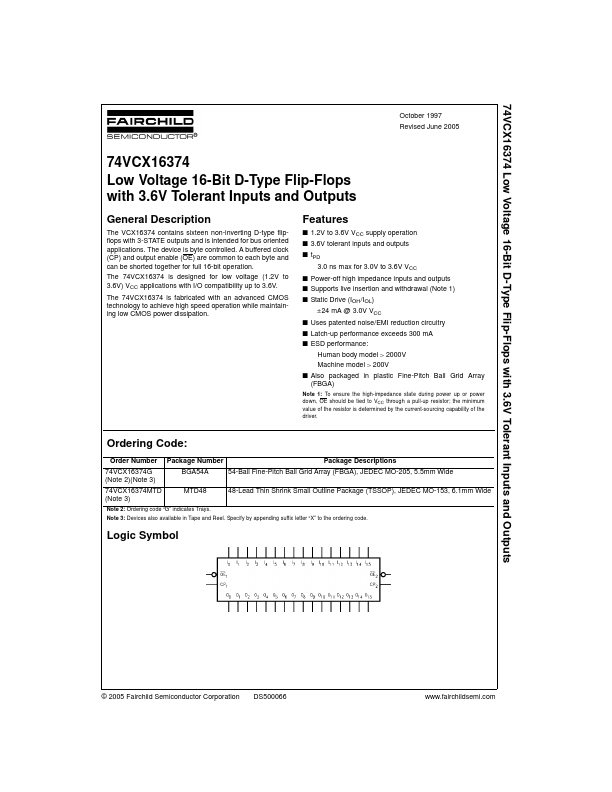
The VCX16374 contains sixteen non-inverting D-type flipflops with 3-STATE outputs and is intended for bus oriented applications.

The device is byte controlled.

A buffered clock (CP) and output enable (OE) are common to each byte and can be shorted together for full 16-bit operation.

Features

  • s 1.2V to 3.6V VCC supply operation s 3.6V tolerant inputs and outputs s tPD 3.0 ns max for 3.0V to 3.6V VCC s Power-off high impedance inputs and outputs s Supports live insertion and withdrawal (Note 1) s Static Drive (IOH/IOL) r24 mA @ 3.0V VCC s Uses patented noise/EMI reduction circuitry s Latch-up performance exceeds 300 mA s ESD performance: Human body model ! 2000V Machine model ! 200V s Also packaged in plastic Fine-Pitch Ball Grid Array (FBGA) Note 1: To ensure the high-impedance st.

📥 Download Datasheet

Datasheet preview – 74VCX16374

Datasheet Details

Part number 74VCX16374
Manufacturer Fairchild Semiconductor
File Size 156.25 KB
Description Low Voltage 16-Bit D-Type Flip-Flop
Datasheet download datasheet 74VCX16374 Datasheet
Additional preview pages of the 74VCX16374 datasheet.
Other Datasheets by Fairchild Semiconductor

Full PDF Text Transcription

Click to expand full text
www.DataSheet4U.com 74VCX16374 Low Voltage 16-Bit D-Type Flip-Flops with 3.6V Tolerant Inputs and Outputs October 1997 Revised June 2005 74VCX16374 Low Voltage 16-Bit D-Type Flip-Flops with 3.6V Tolerant Inputs and Outputs General Description The VCX16374 contains sixteen non-inverting D-type flipflops with 3-STATE outputs and is intended for bus oriented applications. The device is byte controlled. A buffered clock (CP) and output enable (OE) are common to each byte and can be shorted together for full 16-bit operation. The 74VCX16374 is designed for low voltage (1.2V to 3.6V) VCC applications with I/O compatibility up to 3.6V. The 74VCX16374 is fabricated with an advanced CMOS technology to achieve high speed operation while maintaining low CMOS power dissipation. Features s 1.
Published: |