Datasheet4U Logo Datasheet4U.com

FMS6406 - Precision S-Video Filter with Summed Composite Output/ Sound Trap/ and Group Delay Compensation

Description

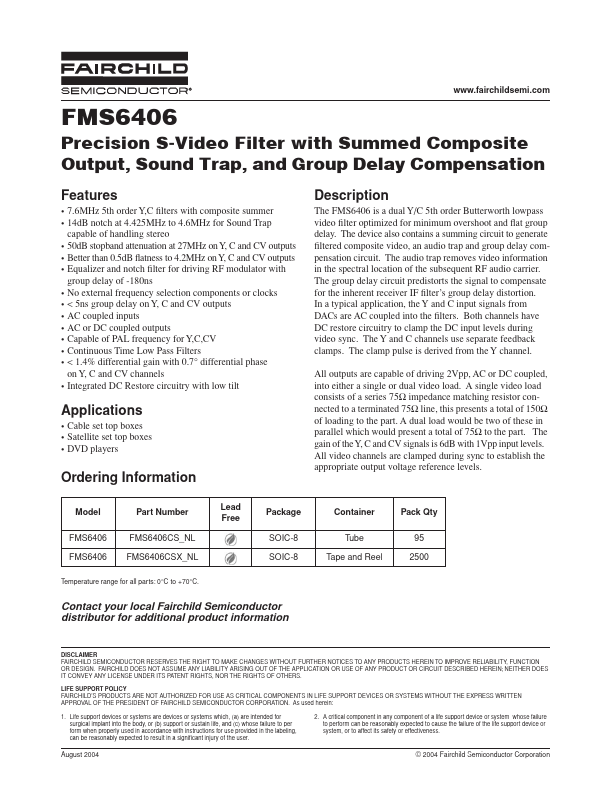
The FMS6406 is a dual Y/C 5th order Butterworth lowpass video filter optimized for minimum overshoot and flat group delay.

The device also contains a summing circuit to generate filtered composite video, an audio trap and group delay compensation circuit.

Features

  • 7.6MHz 5th order Y,C filters with composite summer.
  • 14dB notch at 4.425MHz to 4.6MHz for Sound Trap capable of handling stereo.
  • 50dB stopband attenuation at 27MHz on Y, C and CV outputs.
  • Better than 0.5dB flatness to 4.2MHz on Y, C and CV outputs.
  • Equalizer and notch filter for driving RF modulator with group delay of -180ns.
  • No external frequency selection components or clocks.
  • < 5ns group delay on Y, C and CV outputs.
  • AC cou.

📥 Download Datasheet

Datasheet preview – FMS6406

Datasheet Details

Part number FMS6406
Manufacturer Fairchild Semiconductor (now onsemi)
File Size 52.17 KB
Description Precision S-Video Filter with Summed Composite Output/ Sound Trap/ and Group Delay Compensation
Datasheet download datasheet FMS6406 Datasheet
Additional preview pages of the FMS6406 datasheet.
Other Datasheets by Fairchild Semiconductor

Full PDF Text Transcription

Click to expand full text
www.fairchildsemi.com FMS6406 Precision S-Video Filter with Summed Composite Output, Sound Trap, and Group Delay Compensation Features • 7.6MHz 5th order Y,C filters with composite summer • 14dB notch at 4.425MHz to 4.6MHz for Sound Trap capable of handling stereo • 50dB stopband attenuation at 27MHz on Y, C and CV outputs • Better than 0.5dB flatness to 4.2MHz on Y, C and CV outputs • Equalizer and notch filter for driving RF modulator with group delay of -180ns • No external frequency selection components or clocks • < 5ns group delay on Y, C and CV outputs • AC coupled inputs • AC or DC coupled outputs • Capable of PAL frequency for Y,C,CV • Continuous Time Low Pass Filters • < 1.4% differential gain with 0.
Published: |