
Datasheet4U Logo Datasheet4U.com

FOD814 - 4-Pin DIP Phototransistor Optocouplers

Download the FOD814 datasheet PDF. This datasheet also covers the FOD617 variant, as both devices belong to the same 4-pin dip phototransistor optocouplers family and are provided as variant models within a single manufacturer datasheet.

General Description

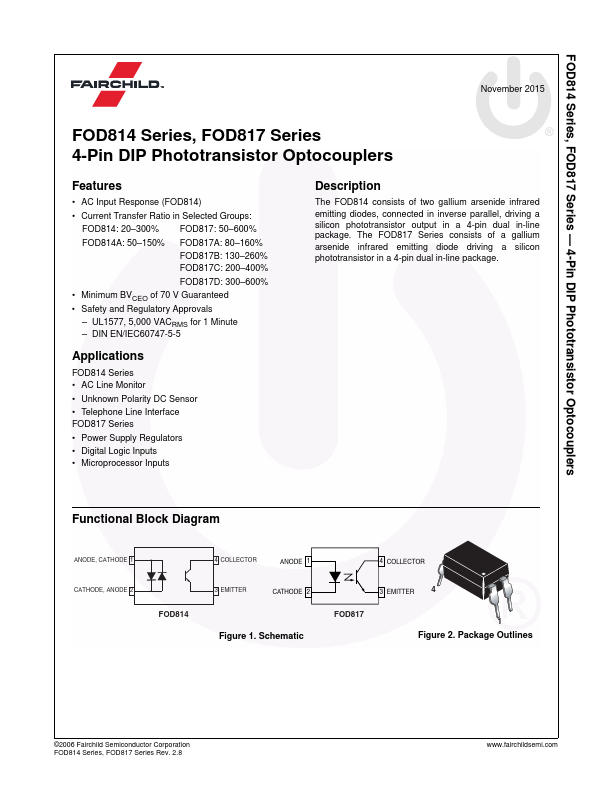
The FOD814 consists of two gallium arsenide infrared emitting diodes, connected in inverse parallel, driving a silicon phototransistor output in a 4-pin dual in-line package.

Key Features

  • AC Input Response (FOD814).
  • Current Transfer Ratio in Selected Groups: FOD814: 20.
  • 300% FOD817: 50.
  • 600% FOD814A: 50.
  • 150% FOD817A: 80.
  • 160% FOD817B: 130.
  • 260% FOD817C: 200.
  • 400% FOD817D: 300.
  • 600%.
  • Minimum BVCEO of 70 V Guaranteed.
  • Safety and Regulatory Approvals.
  • UL1577, 5,000 VACRMS for 1 Minute.
  • DIN EN/IEC60747-5-5.

📥 Download Datasheet

Note: The manufacturer provides a single datasheet file (FOD617_FairchildSemiconductor.pdf) that lists specifications for multiple related part numbers.

Full PDF Text Transcription (Reference)

The following content is an automatically extracted verbatim text from the original manufacturer datasheet and is provided for reference purposes only.

View original datasheet text
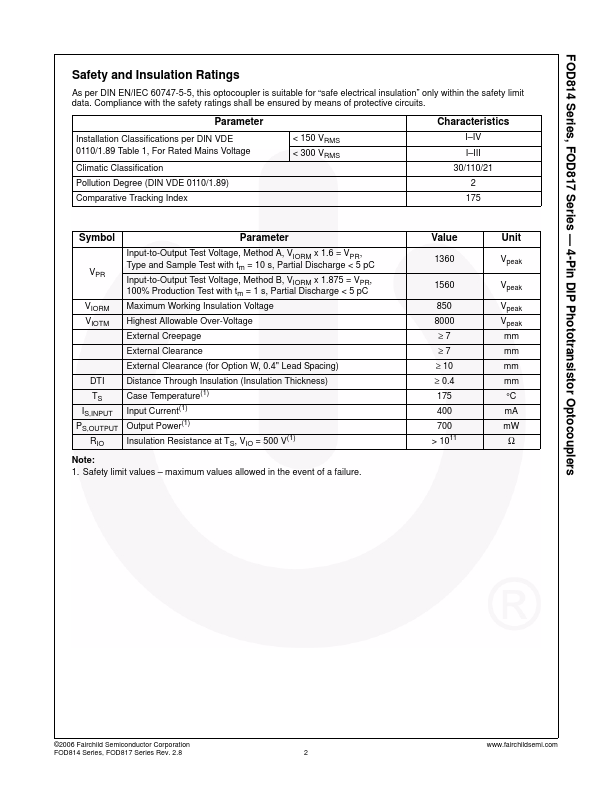
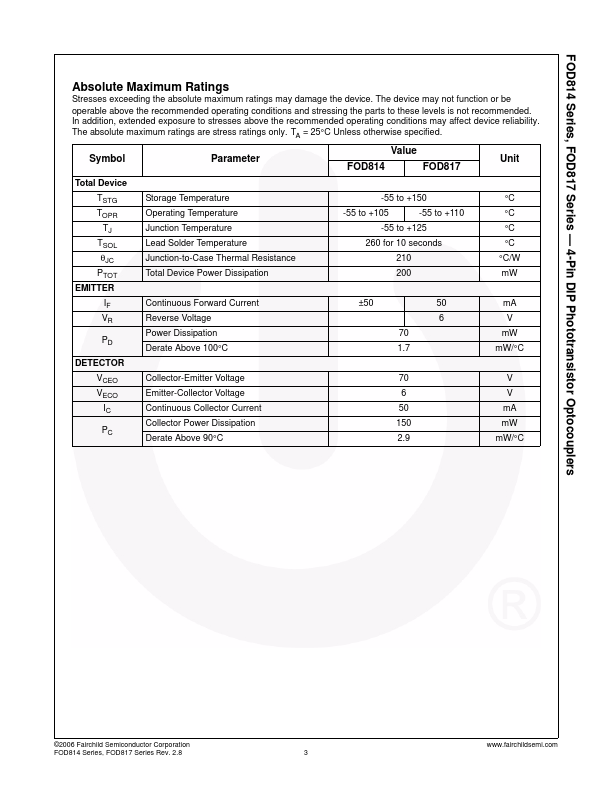
FOD814 Series, FOD817 Series — 4-Pin DIP Phototransistor Optocouplers November 2015 FOD814 Series, FOD817 Series 4-Pin DIP Phototransistor Optocouplers Features • AC Input Response (FOD814) • Current Transfer Ratio in Selected Groups: FOD814: 20–300% FOD817: 50–600% FOD814A: 50–150% FOD817A: 80–160% FOD817B: 130–260% FOD817C: 200–400% FOD817D: 300–600% • Minimum BVCEO of 70 V Guaranteed • Safety and Regulatory Approvals – UL1577, 5,000 VACRMS for 1 Minute – DIN EN/IEC60747-5-5 Applications FOD814 Series • AC Line Monitor • Unknown Polarity DC Sensor • Telephone Line Interface FOD817 Series • Power Supply Regulators • Digital Logic Inputs • Microprocessor Inputs Description The FOD814 consists of two gallium arsenide infrared emitting diodes, connected in inverse parallel, driving a sil