


Datasheet4U Logo Datasheet4U.com

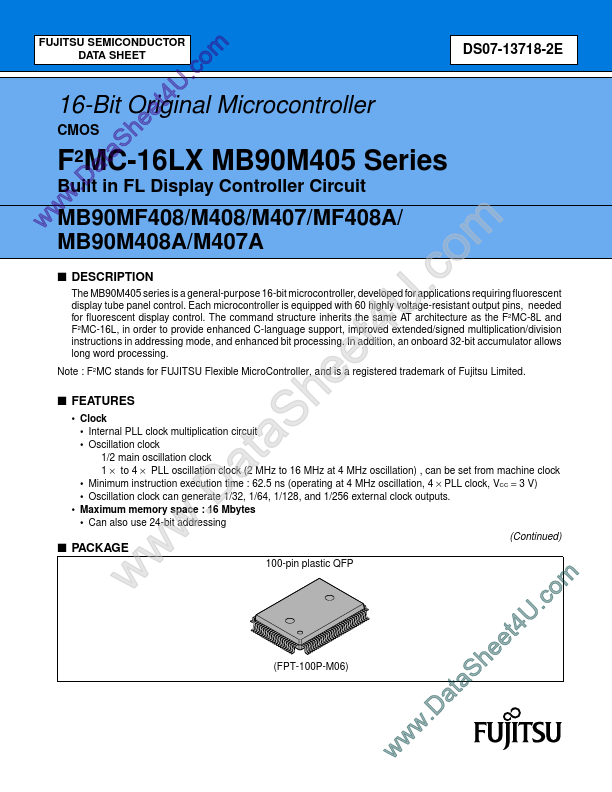
MB90MF408 - (MB90M405 Series) Built in FL Display Controller Circuit

Download the MB90MF408 datasheet PDF. This datasheet also covers the MB90MF407 variant, as both devices belong to the same (mb90m405 series) built in fl display controller circuit family and are provided as variant models within a single manufacturer datasheet.

General Description

The MB90M405 series is a general-purpose 16-bit microcontroller, developed for applications requiring fluorescent display tube panel control.

Each microcontroller is equipped with 60 highly voltage-resistant output pins, needed for fluorescent display control.

Key Features

  • S.
  • Clock.
  • Internal PLL clock multiplication circuit.
  • Oscillation clock 1/2 main oscillation clock 1 × to 4 × PLL oscillation clock (2 MHz to 16 MHz at 4 MHz oscillation) , can be set from machine clock.
  • Minimum instruction execution time : 62.5 ns (operating at 4 MHz oscillation, 4 × PLL clock, VCC = 3 V).
  • Oscillation clock can generate 1/32, 1/64, 1/128, and 1/256 external clock outputs.
  • Maximum memory space : 16 Mbytes.
  • Can also.

📥 Download Datasheet

Note: The manufacturer provides a single datasheet file (MB90MF407_FujitsuMediaDevices.pdf) that lists specifications for multiple related part numbers.

Full PDF Text Transcription (Reference)

The following content is an automatically extracted verbatim text from the original manufacturer datasheet and is provided for reference purposes only.

View original datasheet text
FUJITSU SEMICONDUCTOR DATA SHEET w . U 4 t 16-Bit Original Microcontroller e e CMOS h S a t F2MC-16LX MB90M405 Series a .D in FL Display Controller Circuit Built w w MB90MF408/M408/M407/MF408A/ MB90M408A/M407A ■ DESCRIPTION m o c DS07-13718-2E The MB90M405 series is a general-purpose 16-bit microcontroller, developed for applications requiring fluorescent display tube panel control. Each microcontroller is equipped with 60 highly voltage-resistant output pins, needed for fluorescent display control. The command structure inherits the same AT architecture as the F2MC-8L and F2MC-16L, in order to provide enhanced C-language support, improved extended/signed multiplication/division instructions in addressing mode, and enhanced bit processing.