SSOA
SSOA is SURFACE MOUNT SUPER FAST RECOVERY RECTIFIER manufactured by Good-Ark Semiconductor.
- Part of the SSOA_GOOD comparator family.
- Part of the SSOA_GOOD comparator family.
Features
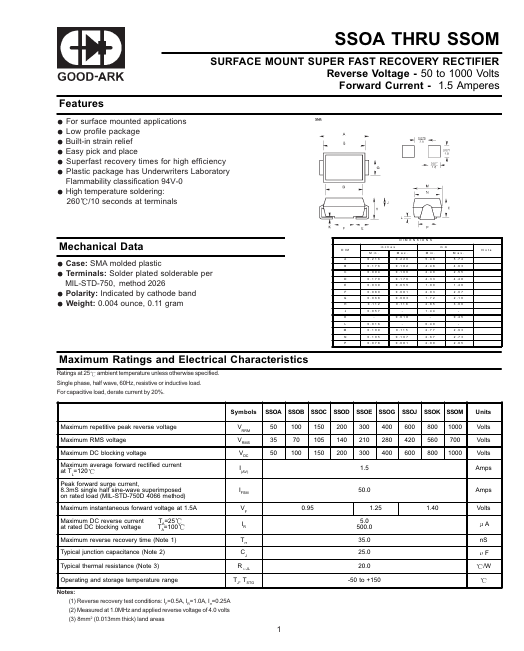
For surface mounted applications Low profile package Built-in strain relief Easy pick and place Superfast recovery times for high efficiency Plastic package has Underwriters Laboratory Flammability classification 94V-0 High temperature soldering: 260 /10 seconds at terminals
Mechanical Data
Case: SMA molded plastic Terminals: Solder plated solderable per MIL-STD-750, method 2026 Polarity: Indicated by cathode band Weight: 0.004 ounce, 0.11 gram
D IM E N S IO N S D IM A B C D E F G H J K L M N P in c h e s M in . 0 .2 1 6 0 .1 7 6 0 .0 9 4 0 .1 7 0 0 .0 3 9 0 .0 8 0 0 .0 6 8 0 .1 1 2 0 .0 5 7 0 .0 1 6 0 .1 0 9 0 .1 0 5 0 .0 7 8 M a x . 0 .2 2 6 0 .1 8 2 0 .1 0 0 0 .1 7 6 0 .0 5 5 0 .0 8 1 0 .0 8 3 0 .1 1 8 0 .0 1 8 0 .1 1 5 0 .1 0 7 0 .0 8 1 M in . 5 .4 8 4 .4 8 2 .4 0 4 .3 3 1 .0 0 2 .0 3 1 .7 2 2 .8 5 1 .4 4 0 .4 0 2 .7 7 2 .6 7 2 .0 0 m m M a x . 5 .7 4 4 .6 3 2 .5 5 4 .4 8 1 .4 0 2 .0 7 2 .1 0 3 .0 0 0 .4 5 2 .9 3 2 .7 3 2 .0 5 N o te
Maximum Ratings and Electrical Characteristics
Ratings at 25 ambient temperature unless otherwise specified. Single phase, half wave, 60Hz, resistive or inductive load. For capacitive load, derate current by 20%.
Symbols
SSOB
SSOC
SSOD
SSOE
SSOG
SSOJ
SSOK SSOM
Units
Maximum repetitive peak reverse voltage Maximum RMS voltage Maximum DC blocking voltage Maximum average forward rectified current at TL=120 Peak forward surge current, 8.3m S single half sine-wave superimposed on rated load (MIL-STD-750D 4066 method) Maximum instantaneous forward voltage at 1.5A Maximum DC reverse current at rated DC blocking voltage TA=25 TA=100
VRRM VRMS VDC I(AV) IFSM VF IR Trr CJ R
50 35 50
100 70 100
150 105 150
200 140 200
300 210 300 1.5 50.0
400 280 400
600 420 600
800 560 800
1000 700 1000
Volts Volts Volts Amps Amps
1.25 5.0 500.0 35.0 25.0 20.0 -50 to +150
Volts A n S F /W
Maximum reverse recovery time (Note 1) Typical junction capacitance (Note 2) Typical thermal resistance (Note 3)...